
Why Portable Power Stations Deliver Less Than Their Rated Capacity
Rated battery capacity describes stored energy. Usable capacity describes what actually reaches a connected device under specific operating or test conditions.
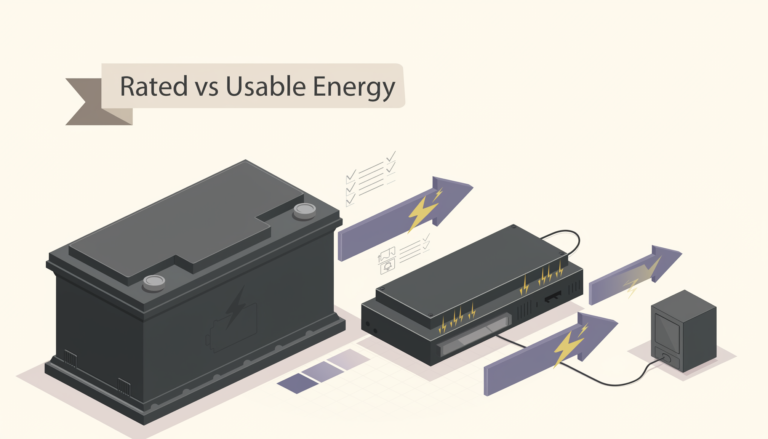
A portable power station normally delivers less usable energy to a connected device than the full watt-hour capacity printed on its specification sheet.
That does not automatically mean the battery is defective or the manufacturer's capacity rating is false.
The rated capacity describes the battery's energy-storage specification. Before that stored energy reaches a connected appliance, some of it can be consumed by:
- the inverter;
- power-conversion electronics;
- battery-management systems;
- displays and control electronics;
- cooling systems;
- standby or idle operation;
- protective operating limits.
The amount of usable energy can also change with:
- output type;
- connected load;
- operating temperature;
- battery condition;
- the power station's design.
This is why a station rated at 1,000Wh should not automatically be treated as though it will deliver exactly 1,000Wh through its AC outlets.
Rated Capacity and Delivered Energy Are Different Measurements
The first distinction is between:
Rated battery capacity
The battery-energy figure published for the power station, usually in watt-hours.
Delivered or usable energy
The amount of energy that reaches the connected load under particular test or operating conditions.
For example, imagine a portable power station with:
If a controlled discharge test measures:
then under those test conditions the station delivered:
of its rated battery capacity to the load.
That does not mean the missing 150Wh simply disappeared.
Some of the stored energy was consumed or unavailable within the complete battery-and-power-conversion system.
Why Doesn't All of the Battery Energy Reach the Appliance?
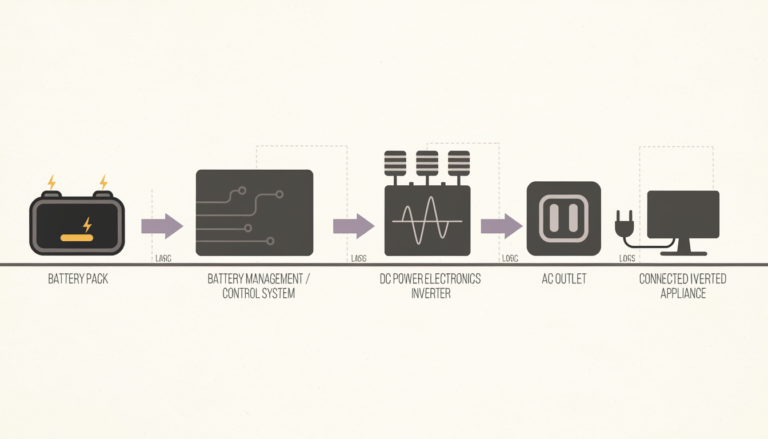
A portable power station is more than a battery.
Energy moves through several systems before reaching a connected device.
Battery
Every conversion and operating stage can consume some energy.
Portable power stations also need electrical power to operate their own components.
As a result:
AC Inverter Losses Reduce Usable Energy
A portable power station battery stores DC electricity.
Household-style AC outlets require alternating current.
The inverter converts the battery's DC electricity into AC electricity for the appliance.
That conversion is not perfectly efficient.
Some stored energy is consumed during the conversion process rather than reaching the load.
The practical consequence is:
AC runtime calculated directly from the rated battery watt-hours can be optimistic.
If accurate usable-AC-energy testing exists for the exact station, that measurement is generally more useful for AC runtime calculations than assuming all rated Wh are available.
The Inverter Can Consume Energy Even at Low Loads
The AC inverter itself needs power to remain active.
This becomes especially important when the connected appliance consumes relatively little power.
Suppose a device uses only a small amount of electricity.
If the inverter and associated AC system also consume energy while active, that fixed overhead can represent a meaningful share of the total battery drain.
As a result, a station may deliver a lower percentage of its rated capacity during a very low AC load than during a larger load.
This does not mean higher loads are always more efficient under every condition.
It means fixed system overhead becomes proportionally more important when the external load is small.
Why Low-Power AC Loads Can Be Misleading
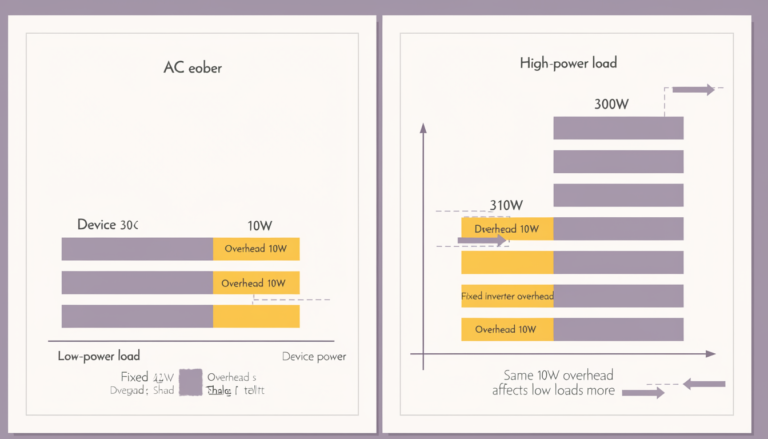
Imagine two hypothetical tests.
Test A
External load:
Station overhead:
Total battery-side demand is influenced by both the external load and system consumption.
The station is spending a substantial amount of energy relative to the size of the external load simply keeping the AC system operating.
Test B
External load:
The same fixed overhead represents a much smaller proportion of the total power being consumed.
This is why runtime for a low-power AC device should not always be estimated using the appliance wattage alone.
The station itself may make up a meaningful part of the total energy demand.
AC, USB and DC Outputs Can Produce Different Results
Not every output uses the same power-conversion path.
A portable power station may provide:
- AC outlets;
- USB-A;
- USB-C;
- 12V DC;
- other DC outputs.
An AC appliance requires the station's inverter.
A compatible USB or DC device may avoid part of that conversion process.
That can affect how much of the stored battery energy eventually reaches the device.
For example, powering a compatible laptop directly from a suitable USB-C output may avoid:
and instead use a more direct DC conversion path.
This does not guarantee a specific efficiency improvement.
Actual performance depends on the station, output circuit, connected device, and load.
But the output type is one reason usable capacity should always be tied to test conditions.
Battery-Management Systems Protect the Battery
Portable power stations contain battery-management systems designed to keep the battery within appropriate operating limits.
Depending on the product, the system can monitor factors such as:
- battery voltage;
- current;
- temperature;
- charging state;
- discharge conditions;
- cell behavior.
The power station does not necessarily allow the battery to be discharged to an electrically absolute zero-energy state.
Protective reserve and cutoff behavior can help prevent conditions that could damage the battery or reduce safe operation.
Therefore:
This is another reason rated battery capacity and delivered energy should not be treated as identical.
The Power Station Uses Energy to Operate Itself
Portable power stations contain internal systems that may consume energy while the unit is operating.
Depending on the model, these can include:
- display;
- control processor;
- battery-management circuitry;
- inverter;
- wireless connectivity;
- cooling fans;
- internal relays;
- voltage-conversion circuits.
For a large external load, this overhead may represent a relatively small share of total battery use.
For a small load operating for many hours, the station's own consumption can become much more significant.
Cooling Fans Can Add to Energy Consumption
Some portable power stations use active cooling.
Fans may operate during:
- high-output use;
- fast charging;
- high internal temperature;
- particular inverter loads.
Fan power is generally not the largest energy consumer in the system, but it is still part of the station's own operating consumption.
Thermal conditions can therefore affect both:
- system behavior;
- total energy consumption.
Load Level Can Change System Efficiency
Power-conversion systems do not necessarily operate with exactly the same efficiency at every load.
A station can behave differently at:
- very low output;
- moderate output;
- high output;
- near its continuous limit.
For this reason, a usable-energy test performed at one load should not automatically be treated as an exact prediction for every other load.
If an independent review measures:
that result is evidence for those test conditions.
It is not automatically:
the station always provides X usable Wh.
Why Independent Usable-Capacity Tests Can Produce Different Numbers
Two credible reviewers can measure different usable-energy results without either result necessarily being fraudulent.
Differences can result from:
- different loads;
- AC versus DC output;
- measurement equipment;
- battery temperature;
- starting state of charge;
- cutoff behavior;
- test duration;
- firmware;
- sample variation.
This means Power Station Scout should record the conditions attached to a usable-capacity measurement whenever those details are available.
A number without its test context is less informative.
Temperature Can Affect Available Battery Energy
Battery performance is temperature-sensitive.
Very cold or hot conditions can change:
- battery behavior;
- internal resistance;
- power availability;
- thermal-management activity;
- charging behavior.
A usable-capacity result measured indoors under moderate conditions should therefore not automatically be assumed to apply unchanged during extreme winter or summer use.
Always follow the manufacturer's specified operating and charging temperature ranges.
Battery Age Can Reduce Available Capacity
Rechargeable batteries gradually lose some capacity as they age and accumulate charge/discharge cycles.
A station that delivered a certain amount of usable energy when new may provide less after substantial degradation.
This means there are at least three separate capacity concepts:
Original rated capacity
The manufacturer's battery specification when the product is new.
New-condition usable energy
What the station can actually deliver under particular conditions when relatively new.
Aged usable energy
What remains after battery degradation.
These should not be confused.
Battery State of Charge Displays Are Estimates
The percentage shown on a power station's display is generated by the battery-management and monitoring system.
A display reading of:
does not necessarily mean that exactly half of the original rated watt-hours remain available to every possible load.
Battery state-of-charge estimation can depend on:
- voltage;
- current;
- battery model;
- operating history;
- calibration methods;
- battery condition.
The display is useful for practical operation, but it should not be treated as laboratory-grade usable-energy measurement.
Why a Station Can Shut Down Before the Display Reaches an Expected Result
Portable power stations are designed to shut down or restrict output when protective thresholds are reached.
Depending on the product and load, this could occur because of:
- low battery voltage;
- overload;
- excessive temperature;
- another protection condition.
Therefore, runtime is ultimately determined by how the complete system behaves—not merely by the theoretical battery energy remaining.
Does Rated Capacity Include the Inverter Loss?
Rated battery capacity normally describes the battery-energy specification itself.
It should not automatically be interpreted as energy already adjusted for every downstream AC conversion loss.
This is why two products with the same rated Wh can produce different measured AC energy.
For product comparisons, keep separate columns for:
- rated Wh;
- measured usable Wh where available.
Do not replace the manufacturer's rated figure with a test result.
Both describe different attributes.
How Do You Calculate Usable-Capacity Percentage?
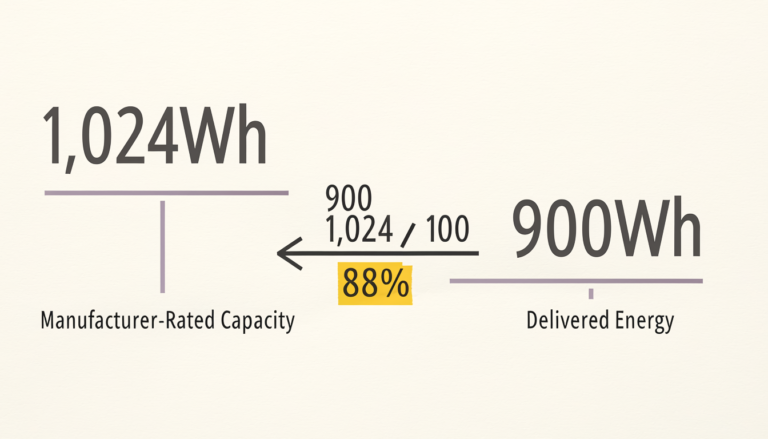
Example:
Rated capacity:
Measured delivered energy:
Calculation:
Under those test conditions, measured delivered energy was approximately:
That conclusion should retain the test context.
Do not generalize it into:
This product is always 88% efficient.
The calculation only compares measured delivered energy with the rated capacity in the specific test.
Is Usable-Capacity Percentage the Same as Inverter Efficiency?
No.
This distinction is important.
A measured:
does not necessarily mean:
the inverter itself is 85% efficient.
The overall result can include energy effects from:
- inverter conversion;
- battery reserve;
- control electronics;
- cooling;
- idle consumption;
- test conditions.
Therefore, Power Station Scout should use language such as:
rather than:
unless inverter efficiency itself was directly measured.
Why This Matters for Runtime Calculations
Using rated capacity directly can overestimate runtime.
Suppose:
- rated capacity = 1,000Wh;
- measured usable AC energy = 850Wh;
- average load = 100W.
Theoretical runtime using rated capacity
Estimated runtime using measured usable energy
The difference is:
1.5 hours
That is why usable energy can materially affect product sizing.
Why the Difference Matters More for Long-Duration Loads
When a device must operate for many hours, overestimating usable energy can produce a substantial runtime error.
This is especially relevant for:
- refrigerator backup;
- freezer backup;
- CPAP backup;
- internet equipment;
- home-office backup;
- overnight camping loads.
A small error in expected runtime may be unimportant for charging a phone.
It can be much more important when the station is supposed to keep an essential device operating through an outage.
Refrigerator Example
Suppose a refrigerator's realistic average consumption over the period being considered corresponds to:
and the power station provides:
Simplified runtime estimate:
If someone instead used:
the theoretical estimate would be:
12.5 hours
That difference could materially affect an outage-backup plan.
This is an illustrative example only; refrigerator consumption varies by exact appliance and operating conditions.
Low-Power Load Example
Suppose a station has:
and powers a very low AC load for a long period.
If its inverter consumes meaningful power simply by remaining active, the total battery drain is greater than the device's wattage alone suggests.
This can produce a surprisingly low percentage of delivered energy compared with a higher-load discharge test.
For low-power devices, check whether:
- a compatible USB output;
- a USB-C output;
- a DC output
can be used instead of leaving the AC inverter active.
The real benefit is product-specific, so avoid promising a fixed improvement.
Why You Should Not Assume “80% Usable” for Every Station
Generic formulas sometimes use:
or another fixed percentage.
That can be convenient for rough planning.
It should not be confused with product-specific evidence.
Independent testing shows that:
- models differ;
- loads differ;
- low- and high-draw tests can differ significantly.
The correct editorial treatment is:
If measured data exists
Use it and identify the test conditions.
If measured data does not exist
Use a clearly stated planning assumption.
Never
Present a generic percentage as though Power Station Scout measured it.
How Power Station Scout Should Report Capacity
For product reviews, use separate terminology.
Manufacturer-rated capacity
Example:
The manufacturer specifies a 1,024Wh battery.
Independently measured usable energy
Example:
Independent testing delivered approximately X Wh through AC under the reported test conditions.
Power Station Scout calculation
Example:
Using X Wh of measured usable energy and a 100W average load, the estimated runtime is approximately Y hours.
These three statements should never be collapsed into one.
Should You Compare Products by Rated Wh or Usable Wh?
Use both when reliable data exists.
Rated Wh helps compare:
- nominal battery size;
- manufacturer specifications;
- product classes.
Measured usable Wh helps compare:
- energy actually delivered during a particular test;
- runtime potential under similar conditions;
- value per usable Wh.
However, usable-energy comparisons are strongest when products were tested:
- with similar methodology;
- at similar load levels;
- through the same output type.
Comparing unrelated tests from different reviewers can introduce methodological differences.
What Is Price per Usable Watt-Hour?
When credible usable-energy data exists, a useful derived metric is:
Example:
Price:
Measured usable energy:
Calculation:
This can provide more decision value than:
because it incorporates measured delivered energy.
However:
- price changes;
- test methodology matters;
- value involves more than battery capacity.
A station with a low price per usable Wh may still be inappropriate if its output or features do not meet the user's requirements.
Should Usable Capacity Determine Which Power Station You Buy?
It is an important attribute, but not the only one.
A complete decision still needs to evaluate:
- continuous output;
- startup capability;
- battery capacity;
- charging speed;
- battery chemistry;
- weight;
- ports;
- UPS/EPS;
- expansion;
- warranty;
- price.
A highly efficient station with insufficient output is still unsuitable for the load.
A slightly less efficient station may be the better choice if its overall specification profile better matches the use case.
How to Plan When No Usable-Capacity Test Exists
If independent usable-energy data is unavailable:
Step 1
Use the manufacturer-rated capacity.
Step 2
Calculate the theoretical energy requirement of your load.
Step 3
Apply a conservative planning allowance for conversion/system losses.
Step 4
Clearly record that the allowance is an assumption.
Step 5
Avoid false precision.
Do not state:
Runtime is exactly 7.83 hours.
Prefer:
Under these assumptions, estimated runtime is approximately eight hours.
Common Usable-Capacity Mistakes
Treating rated Wh as delivered Wh
They are not necessarily the same.
Calling all missing energy “inverter loss”
Other system factors also contribute.
Calling usable-percentage results “inverter efficiency”
Those measurements are not necessarily equivalent.
Using one fixed percentage for every power station
Real results differ by model and conditions.
Ignoring load level
Low AC loads can be disproportionately affected by fixed inverter consumption.
Ignoring output type
AC, USB and DC paths can behave differently.
Mixing unrelated test methodologies
Usable-energy results are most comparable when tests are conducted similarly.
Ignoring battery age
Usable capacity can decline over time.
Presenting calculated usable energy as measured
Calculations and tests must remain distinct.
Assuming lower-than-rated output means a defective battery
Some difference is expected because the full power system consumes energy.
Usable Capacity Checklist
Rated specification
- Exact model identified
- Exact generation identified
- Manufacturer-rated Wh recorded
Test data
- Usable-energy test available?
- AC, DC or USB output identified?
- Test load recorded?
- Starting battery state recorded where available?
- Test methodology credible?
- Measured Wh separated from rated Wh?
Interpretation
- Delivered percentage calculated correctly
- Result not mislabeled as inverter efficiency
- Test conditions preserved
- No universal percentage assumed
Runtime
- Usable Wh used when available
- Average load used
- Estimate labeled correctly
- Operating conditions considered
Frequently Asked Questions
Why does my 1,000Wh power station not deliver 1,000Wh through AC?
Because rated battery capacity is not the same as energy delivered to the AC load. The inverter and other station electronics consume energy, and system operating limits affect usable output.
Is a power station defective if usable energy is lower than rated capacity?
Not necessarily. Some difference between rated battery energy and delivered energy is expected. Whether a particular result is normal depends on the exact model and test conditions.
What percentage of rated capacity should a power station deliver?
There is no single percentage that applies to every station and every load. Use product-specific test data when available.
Why can a small AC load get worse runtime than expected?
The inverter and AC system can consume energy even when the external load is small, making fixed system overhead proportionally more important.
Is DC more efficient than AC?
It can avoid the AC inverter for compatible devices, but the actual efficiency difference depends on the station, output circuit and device.
Does battery capacity shrink over time?
Rechargeable batteries can lose capacity as they age and accumulate cycles, which can reduce runtime.
Should I use rated or usable Wh for runtime?
Use credible measured usable Wh when available. Otherwise use rated Wh with a clearly stated allowance for real-world system losses.
The Bottom Line
Portable power stations deliver less usable energy than their headline battery capacity because the complete system consumes and controls energy before it reaches the connected device.
Important contributors can include:
- inverter conversion losses;
- inverter idle consumption;
- control electronics;
- battery-management systems;
- cooling;
- protective reserve and cutoff behavior;
- output type;
- load level;
- temperature;
- battery age.
The key distinction is:
while:
For realistic runtime calculations, measured usable energy is more useful than rated Wh alone when credible testing exists.
And when it does not exist, use a transparent planning assumption rather than pretending every portable power station has the same efficiency.
Related sizing guides
Portable power station sizing · Capacity explained · Watts vs watt-hours · Runtime calculations · Refrigerator sizing · Battery lifespan · Temperature guidance
Use usable energy for realistic runtime planning
Keep manufacturer-rated capacity, measured usable energy, and calculated runtime as separate attributes so comparisons remain accurate.
Calculate Portable Power Station Runtime