
Can You Use a Portable Power Station in Hot or Cold Weather?
Yes, portable power stations can operate in hot and cold weather, but charging, discharging, and storage temperature limits are different—and they vary by exact model.
Temperature rules are model-specific—and charging is not the same as discharging
A power station may be able to run appliances below freezing while refusing to charge its battery at the same temperature.
For example, current EcoFlow RIVER 2 Pro specifications permit discharge from 14°F to 113°F (-10°C to 45°C) but charging only from 32°F to 113°F (0°C to 45°C). Current Jackery Explorer 300 V2 specifications similarly permit discharge down to approximately 5°F (-15°C) while its normal charging range starts at 32°F (0°C).
Some newer systems extend cold-weather operation through battery heating or different thermal designs. EcoFlow's DELTA Pro Ultra, for example, includes configurable battery preconditioning and can use incoming energy to heat its battery before charging below freezing.
So the most important rule is:
Temperature affects:
- whether the battery will accept a charge;
- how much usable energy is available;
- power capability;
- charging speed;
- battery protection behavior;
- battery aging;
- solar charging;
- long-term storage.
Charging vs Discharging vs Storage Temperature
Use the exact manual for the specific model; there is no single universal temperature range.

Portable power station specifications commonly provide three separate temperature ranges.
Charging Temperature
The temperature range in which the battery can safely accept charging.
This applies when charging through:
- AC wall power;
- solar;
- car charging;
- alternator charging;
- another supported input.
Discharging Temperature
The temperature range in which the battery can supply power to connected devices.
Storage Temperature
The allowable temperature range while the station is being stored rather than actively operated.
These ranges may overlap, but they are not necessarily identical.
Example Temperature Ranges
Current manufacturer specifications illustrate how much model behavior varies.
| Portable Power Station | Charging | Discharging | Important Note |
|---|---|---|---|
| EcoFlow RIVER 2 Pro | 32–113°F / 0–45°C | 14–113°F / -10–45°C | LFP |
| EcoFlow DELTA 3 Classic | 32–113°F / 0–45°C | 14–113°F / -10–45°C | Low-temp protection |
| Jackery Explorer 300 V2 | 32–113°F / 0–45°C | 5–113°F / -15–45°C | LFP |
| BLUETTI AC2P | 32–104°F / 0–40°C | -4–104°F / -20–40°C | LFP |
| Jackery HomePower 3600 Plus | -4–113°F / -20–45°C | -4–113°F / -20–45°C | Wider manufacturer-stated operating range |
These are model-specific manufacturer specifications, not universal limits for each brand.
The variation is exactly why a general statement such as:
“LiFePO4 power stations cannot charge below 32°F”
would be too broad.
Many conventional models prohibit ordinary charging below 32°F, but systems with appropriate thermal management can behave differently.
Can You Use a Portable Power Station Below Freezing?
Do not assume a generic cutoff temperature and do not bypass a temperature warning.
Often, yes.
Many models can discharge below 32°F (0°C) even when they will not accept a charge at that temperature.
For example:
- EcoFlow RIVER 2 Pro: discharge to 14°F (-10°C);
- Jackery Explorer 300 V2: discharge to about 5°F (-15°C);
- BLUETTI AC2P: discharge to -4°F (-20°C).
But cold-weather operation can reduce performance.
At low temperature, lithium-ion battery:
- internal resistance increases;
- electrochemical reactions slow;
- available power can decline;
- usable capacity can decline.
Peer-reviewed reviews of lithium-ion battery behavior consistently find reduced available energy and power at low temperature and increased internal resistance.
Therefore:
A power station that works at 10°F may not provide the same runtime or high-load performance that it provides at 70°F.
Why Does Cold Weather Reduce Battery Performance?
Lithium-ion batteries depend on ions moving through:
- electrolyte;
- electrodes;
- interfaces inside the cell.
Cold temperatures slow those processes.
As temperature drops:
internal resistance rises
→ voltage drops more under load
→ available power can decrease
→ usable capacity can decrease
This is why a power station may show:
- shorter runtime;
- lower available output;
- faster displayed battery decline
in very cold conditions.
A 2023 scientific review of low-temperature lithium-ion batteries describes reduced charging/discharging performance, increased resistance, and reduced available capacity as temperature falls.
Does Cold Weather Permanently Reduce Battery Capacity?
Not necessarily.
Some apparent cold-weather capacity loss is temporary.
When a cold battery returns to a moderate temperature, some of the previously unavailable capacity may again become usable.
But repeatedly operating or especially charging a battery outside its permitted temperature range can contribute to actual degradation.
The correct distinction is:
Temporary Cold-Weather Performance Loss
Battery delivers less useful energy while cold.
Permanent Battery Degradation
Long-term loss of capacity caused by aging or damaging operating conditions.
Do not assume every reduction in winter runtime means the battery has permanently worn out.
Why Is Charging in the Cold More Restricted Than Discharging?
Charging a lithium-ion battery at low temperature creates different electrochemical risks from simply discharging it.
At sufficiently low temperature, lithium ions may not move into the graphite anode quickly enough during charging.
Under unsuitable charging conditions, metallic lithium can deposit on the anode surface, a process known as lithium plating.
Scientific reviews identify low-temperature charging and lithium plating as important degradation and safety concerns.
That is one reason many portable power stations allow:
cold discharge
while preventing:
cold charging.
Can You Charge a Portable Power Station Below 32°F?
Sometimes—but only if the exact model is designed to do so.
For many common models, normal charging begins at:
32°F / 0°C
Examples include:
- EcoFlow RIVER 2 Pro;
- EcoFlow DELTA 3 Classic;
- Jackery Explorer 300 V2;
- BLUETTI AC2P.
But newer cold-weather systems can differ.
Current Jackery HomePower 3600 Plus documentation, for example, publishes a charging range down to -4°F (-20°C).
That does not mean another Jackery product can charge at -20°C.
Exact model specification controls.
What Is Low-Temperature Charging Protection?
Many portable power stations contain a Battery Management System, or BMS, that monitors battery temperature.
If the battery is too cold, the BMS may:
- stop charging;
- show a low-temperature warning;
- wait until battery temperature rises.
For example, EcoFlow DELTA 3 Classic documentation states that low-temperature charging protection stops charging and resumes automatically once battery temperature rises above the specified threshold.
This behavior is a safety feature.
Do not repeatedly:
- reconnect the charger;
- restart the unit;
- attempt to bypass the warning.
Allow the battery to reach a permitted charging temperature.
Can a Power Station Still Power Devices When It Says “Too Cold to Charge”?
Potentially, yes.
Charging and discharge temperature thresholds can be different.
A cold station may therefore:
- reject AC charging;
- reject solar charging;
while still:
- powering a router;
- running lights;
- operating another compatible device.
Whether it can do so depends on the exact model's discharge range.
What Should You Do if the Power Station Is Too Cold to Charge?
Use this sequence:
- Stop trying to force charging.
- Move the station to a warmer environment.
- Keep it dry.
- Allow the internal battery temperature to rise naturally.
- Wait for the low-temperature warning to clear.
- Resume charging only within the model's specified range.
Do not heat the battery with:
- open flame;
- heat gun;
- space heater placed directly against it;
- other uncontrolled high-temperature sources.
The goal is to bring the battery gradually into its supported operating range.
Can You Bring a Frozen Power Station Indoors and Charge It Immediately?
Not necessarily.
The outside enclosure may warm faster than the battery cells inside.
If a station has been sitting overnight in:
- a freezing vehicle;
- an unheated shed;
- severe winter conditions;
its internal battery can remain cold after the exterior begins to feel warmer.
Allow sufficient time for the battery to stabilize.
If the power station displays:
- battery temperature;
- low-temperature protection status;
use that information.
What Is Battery Preheating?
Do not improvise external battery heating or assume every portable power station supports this sequence.
Some advanced portable power stations include built-in battery heating.
Instead of requiring the battery to be manually warmed before charging, the system can use incoming power to warm the cells first.
EcoFlow's DELTA Pro Ultra provides a current example.
Its battery preconditioning system can automatically initiate charging heating below 32°F (0°C) when sufficient charging input is available. EcoFlow specifies that charging heating operates between -4°F and 32°F (-20°C to 0°C), requires at least 250W of charging input, and transitions into normal battery charging as the internal battery warms.
This is fundamentally different from simply forcing current into an ordinary frozen battery.
Does Every LiFePO4 Power Station Have Self-Heating?
No.
LiFePO4 describes the cell chemistry.
It does not automatically provide:
- battery heaters;
- preconditioning;
- cold charging;
- automatic warming.
Two LFP portable power stations can have very different cold-weather capabilities because their:
- thermal systems;
- BMS;
- pack design
are different.
Always verify the model.
Is LiFePO4 Good in Cold Weather?
LFP can be used in cold environments when the pack is designed appropriately, but it is incorrect to describe it as immune to low-temperature effects.
Cold can still reduce:
- available capacity;
- charge acceptance;
- power.
A model's thermal design matters alongside cell chemistry.
Can NMC Power Stations Work Better in the Cold?
Battery chemistry can influence temperature behavior, but the final portable power station specification is more useful than trying to choose entirely from chemistry.
A well-designed station with:
- temperature protection;
- heaters;
- thermal management
may outperform another station with a theoretically favorable chemistry.
For buying decisions:
Check the exact charge/discharge temperature specification instead of assuming chemistry alone determines winter performance.
Can You Use a Portable Power Station at 20°F?
Potentially.
20°F is approximately:
-7°C
Many models whose discharge range extends to:
-10°C, -15°C, or -20°C
can still supply power at that temperature.
But many of those same models should not be charged at 20°F.
Therefore:
Using stored battery energy at 20°F
may be supported.
Recharging the battery at 20°F
may be prohibited unless the station has appropriate low-temperature charging capability.
Can You Use One at 0°F?
Possibly, but far fewer assumptions should be made.
0°F is about:
-18°C
A station must explicitly support discharge at that temperature.
For example, BLUETTI AC2P currently specifies discharge down to -4°F (-20°C), while EcoFlow RIVER 2 Pro only specifies discharge down to 14°F (-10°C).
So one product may still be within specification while another is outside it.
Can You Use a Portable Power Station in Snow?
Cold and moisture are separate problems.
A station may be electrically capable of operating below freezing while not being weatherproof enough for snow exposure.
Snow can melt into water.
Therefore:
- keep the power station dry;
- protect ports and vents;
- check the exact IP/environmental rating.
A cold-weather operating range is not the same as a waterproof rating.
Can You Use a Portable Power Station in a Tent During Winter?
Potentially, provided:
- the station remains dry;
- ventilation is unobstructed;
- temperature remains within its operating range.
A battery station does not create combustion exhaust like a fuel generator.
But never place a fuel-burning:
- generator;
- heater
inside the tent simply because the battery power station is there.
Also avoid positioning the battery directly beside:
- a stove;
- portable heater;
- open flame.
How Do You Keep a Power Station Warmer in Winter?
The safest strategy is usually environmental rather than improvised heating.
When possible:
- keep the station indoors before use;
- keep it inside a temperature-controlled vehicle cabin rather than an exposed truck bed;
- protect it from direct contact with frozen ground;
- keep it in a dry sheltered environment;
- use manufacturer-provided battery heating when available.
Do not block cooling/ventilation simply to retain heat.
Insulating a station so heavily that it cannot dissipate heat once operating creates a different problem.
Can You Wrap a Power Station in a Blanket in Cold Weather?
Do not cover cooling vents while the station is operating or charging.
Although insulation might appear useful in cold conditions, the inverter and battery can generate their own heat.
Once active, the station still needs thermal management.
A manufacturer-designed cold-weather enclosure is preferable to improvised coverings that block airflow.
Does Running a Load Warm the Battery?
Battery discharge and power electronics generate some heat.
A station that is actively supplying a substantial load may therefore warm internally.
However:
Do not use a high-power appliance solely as a battery-heating technique unless the manufacturer specifically recommends such behavior.
The BMS should determine whether the station is within its supported temperature range.
Can Solar Panels Charge a Cold Power Station?
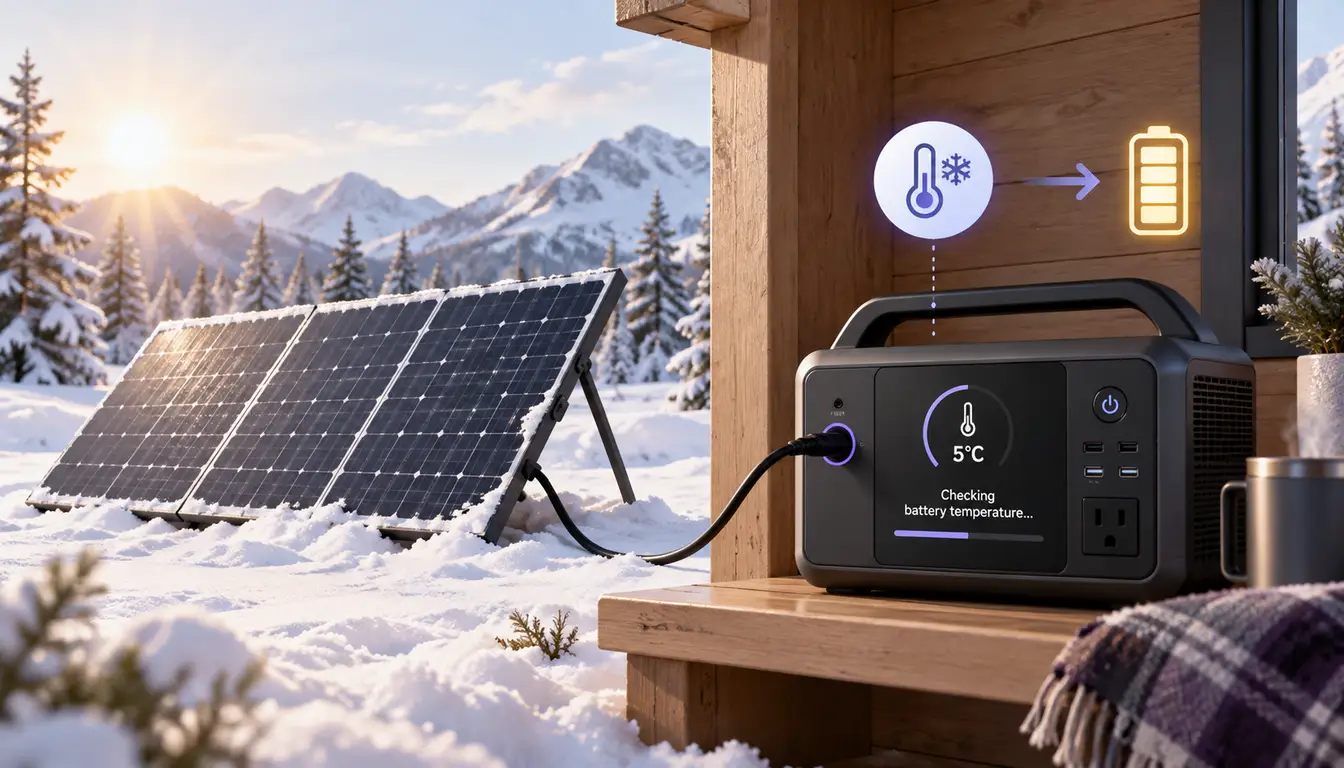
Solar panels can produce electricity in cold weather.
But whether that energy enters the battery depends on the power station's battery charging temperature.
Example:
Solar input available:
300W
Battery temperature:
below model's charging minimum.
The solar array may be producing energy while the BMS refuses battery charging.
If the station has battery preheating, some incoming solar energy may potentially be used for thermal conditioning depending on the exact product architecture.
Otherwise, the battery may need to warm first.
Solar Panels Can Produce Higher Voltage in Cold Weather
There is another winter issue:
solar panel voltage can rise as panel temperature falls.
This matters when using panels in series.
An array that remains below a power station's maximum solar-input voltage during warm weather can move closer to that limit in cold conditions.
Therefore winter solar planning must consider both:
Battery temperature
Can the station accept charging?
and:
Panel voltage
Does cold-weather array Voc remain below the station's maximum input voltage?
Do not confuse these two temperature effects.
Does Cold Weather Reduce Solar Panel Output?
Cold itself does not necessarily reduce photovoltaic efficiency; solar panels can operate efficiently in cold temperatures.
The winter problem is often reduced available sunlight from:
- shorter days;
- lower sun angle;
- clouds;
- snow coverage.
Meanwhile, very low battery temperature may prevent the power station from accepting the available energy.
For off-grid winter planning, consider:
solar energy availability
and:
battery charging temperature
separately.
Does Snow on a Solar Panel Matter?
Yes.
Snow covering the active photovoltaic surface blocks sunlight and can sharply reduce output.
Clear snow only when it can be done safely and without damaging the panel.
Do not create an electrical or fall hazard while trying to recover a small amount of solar power.
Can You Use a Portable Power Station in Hot Weather?
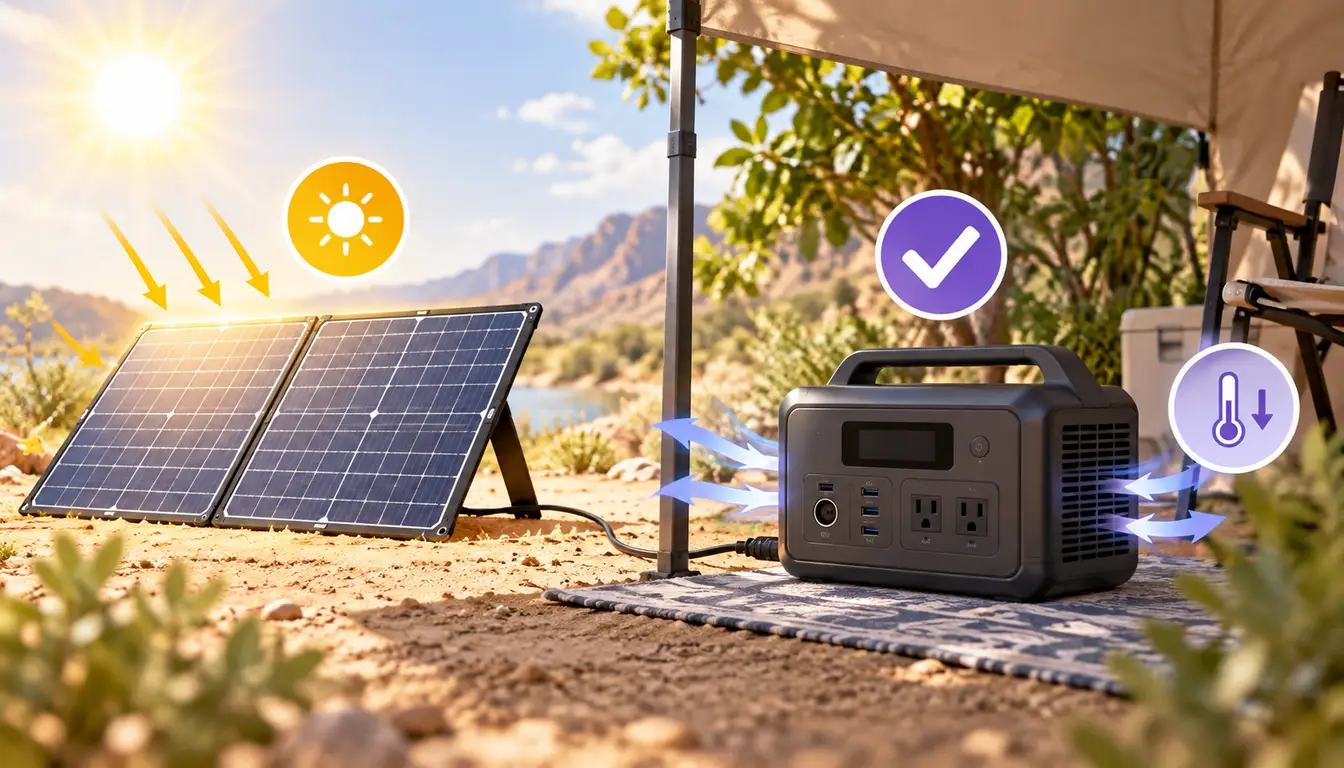
Yes, within the model's permitted operating range.
Many current products specify maximum charging/discharging temperatures around:
104°F to 113°F (40°C to 45°C)
depending on the model.
For example:
- BLUETTI AC2P: up to 104°F / 40°C;
- EcoFlow RIVER 2 Pro: up to 113°F / 45°C;
- Jackery Explorer 300 V2: up to 113°F / 45°C.
Again, do not treat 113°F as a universal portable power station limit.
What Happens When a Portable Power Station Gets Too Hot?
The station may:
- reduce charging;
- reduce output;
- increase fan speed;
- show a high-temperature warning;
- stop charging;
- shut down output.
For example, EcoFlow DELTA 3 documentation instructs users to stop operation and move the station away from heat into a well-ventilated location when high-temperature protection is triggered.
Jackery similarly instructs users experiencing temperature warnings to stop inputs and outputs and allow the unit to return to its specified operating range.
These protections should not be treated as nuisances to bypass.
Why Does Heat Affect Batteries?
High temperature accelerates many chemical reactions inside lithium-ion cells.
Over time, elevated temperature can increase:
- calendar aging;
- capacity loss;
- resistance growth.
Peer-reviewed lithium-ion aging research consistently identifies temperature as a major factor influencing battery degradation, with higher-temperature storage and operation generally accelerating aging.
Therefore:
A battery may still operate within its absolute maximum temperature specification while aging faster than it would in a moderate environment.
Allowed and ideal for longevity are not the same thing.
What Is the Best Temperature for a Portable Power Station?
There is no universal single perfect temperature, but moderate room-like temperatures are generally easier on lithium-ion batteries than temperature extremes.
Some manufacturers publish an optimal range separately from their allowable range.
EcoFlow DELTA 3 Classic, for example, specifies an optimal operating temperature of 68–86°F (20–30°C) while allowing charging/discharging over a wider range.
That distinction is useful:
Allowed Range
The product is designed to operate within these limits.
Optimal Range
Conditions where performance and battery behavior are generally more favorable.
Can You Use a Portable Power Station at 100°F?
Often, yes.
100°F is approximately:
38°C
That is within the published operating range of many current power stations.
But consider:
- direct sunlight;
- internal heat generation;
- charging;
- high loads.
Ambient temperature may be:
100°F
while internal battery or electronics temperature becomes higher.
Provide ventilation and shade when practical.
Can You Use a Portable Power Station at 110°F?
Some models permit operation up to approximately:
113°F / 45°C.
Others stop at:
104°F / 40°C.
Therefore 110°F may be:
- inside specification for one model;
- outside specification for another.
Check the exact manual.
Even when technically permitted, avoid unnecessary:
- direct sun;
- enclosed spaces;
- high-power charging
at extreme ambient temperatures.
Why Direct Sunlight Is Different From Air Temperature
Suppose the forecast temperature is:
95°F
A dark enclosure sitting in direct sunlight can become significantly hotter than the surrounding air.
That means:
ambient air temperature
is not necessarily:
battery enclosure temperature.
For outdoor solar charging:
Put the solar panel in the sun and keep the power station shaded when practical.
The battery does not need sunlight.
Can You Leave a Portable Power Station in a Hot Car?
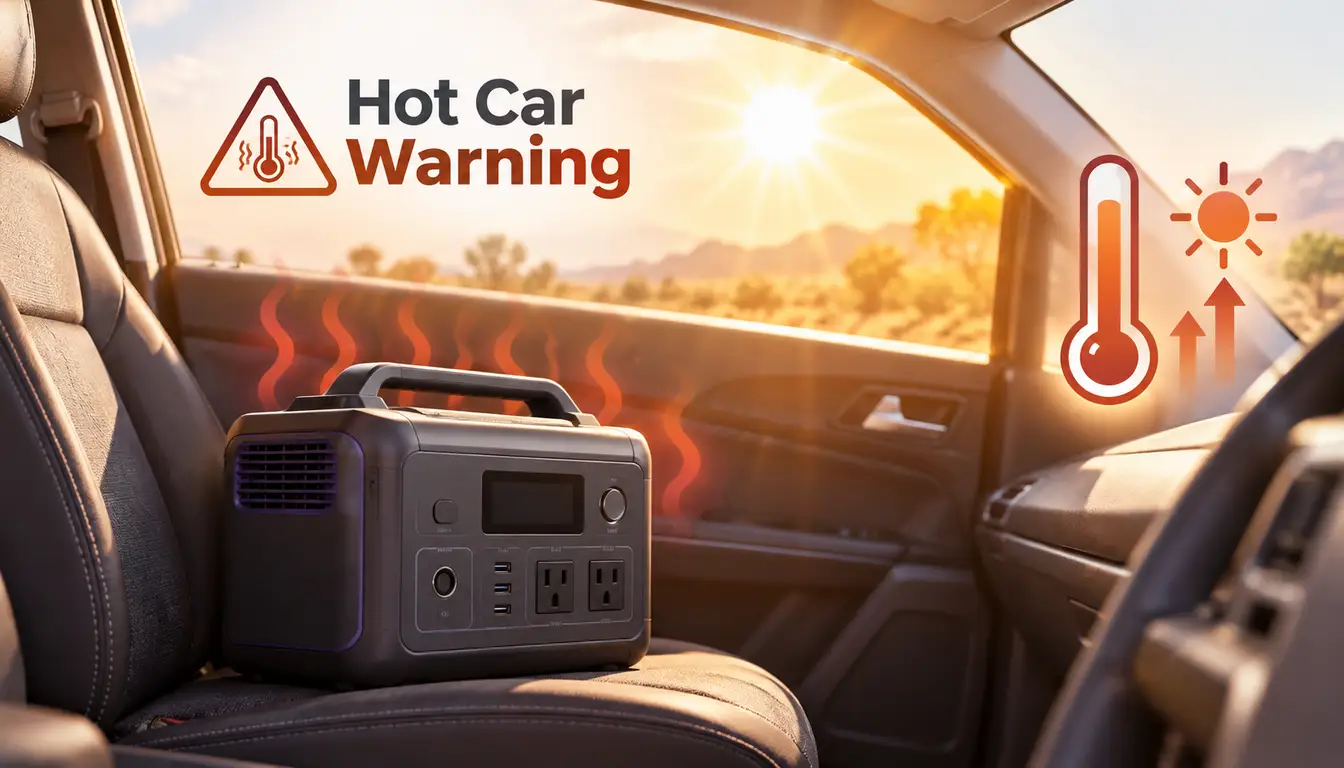
Avoid long-term storage in a hot vehicle.
Vehicle interiors can become far hotter than outdoor ambient temperature.
Current Jackery long-term storage guidance specifically warns against leaving portable power stations in vehicles because summer cabin temperatures can exceed the recommended storage range.
This is especially important for:
- black dashboards;
- closed trunks;
- parked vehicles in direct sunlight.
What If You Need to Carry One in a Vehicle?
Vehicle transport is normal for portable power stations.
The concern is prolonged exposure to excessive heat.
When transporting:
- secure the station;
- avoid leaving it in a parked hot vehicle for extended periods;
- keep it away from direct sun where practical;
- follow the exact storage/operating range.
Can You Charge a Power Station in a Hot Car?
Only if:
- ambient/internal temperature remains within the charging range;
- the model permits vehicle charging under those conditions.
Vehicle charging already produces:
- charging heat;
- cable heat.
A hot interior adds thermal stress.
If the station reports high-temperature protection, stop charging and allow it to cool.
Is a Warm Power Station Normal While Charging?
Some warmth can be normal.
Charging electronics and battery cells generate heat.
Jackery's current support documentation notes that its stations and charging cables can become warm during AC or car charging under normal operation.
However, one manufacturer's allowable surface-temperature figure should not be generalized to every brand.
Use model-specific warnings and thresholds.
Why Does the Fan Run More in Hot Weather?
Cooling fans remove heat from:
- battery;
- inverter;
- charger;
- internal electronics.
Fan speed can therefore increase when:
- charging rapidly;
- powering a high load;
- ambient temperature rises.
Fan noise by itself is not proof of a problem.
Concern increases if it is accompanied by:
- thermal warning;
- shutdown;
- unusual smell;
- smoke.
Does Hot Weather Reduce Runtime?
It can affect battery behavior, but there is no simple universal percentage.
At moderate warmth, a battery may initially appear to deliver energy readily.
At higher temperature:
- thermal protection can restrict operation;
- cooling fans can consume additional power;
- sustained high temperatures increase aging stress.
Avoid generic claims such as:
“You lose 20% runtime at 100°F.”
Without exact product testing, such numbers are unsupported.
Does Cold Weather Reduce Runtime?
Yes, often.
Because low temperature increases internal resistance and can reduce available capacity, a station may provide less usable energy at the same load.
But the reduction depends on:
- chemistry;
- cell design;
- battery temperature;
- discharge rate;
- power station thermal management.
Use independent measured data for exact percentages.
Do not invent a universal cold-weather efficiency factor.
Why High-Power Loads Are Harder in the Cold
High loads require high current from the battery.
At low temperature:
battery resistance rises
so:
voltage drop under high current becomes greater.
A cold station may therefore handle:
100W
comfortably while struggling with:
1,500W
even if both are technically within the normal room-temperature inverter rating.
Some products may limit output automatically in these conditions.
Does the Inverter Rating Change With Temperature?
The advertised continuous output is normally a product rating under specified conditions.
Actual available output can be subject to:
- thermal protection;
- low-temperature protection;
- product-specific derating.
Do not assume a station will provide its full rated output at the extreme edge of its operating range unless the manufacturer explicitly states that it will.
For model reviews, check whether the manufacturer publishes:
- temperature-based power derating.
Can You Run a Refrigerator From a Cold Power Station?
Potentially, if:
- battery temperature is within discharge range;
- station continuous output is adequate;
- surge capability is adequate.
Cold weather does not remove the refrigerator's compressor-start requirement.
Can You Use a Power Station for Winter Camping?
Yes, but plan around both:
energy demand
and:
battery temperature.
Winter camping can increase energy requirements from:
- heated blankets;
- electronics;
- lighting;
- other equipment.
Meanwhile, the battery may provide less usable energy in the cold.
Keep the station:
- dry;
- within discharge range;
- protected from unnecessary cold;
- away from combustion heaters or open flame.
Can You Use One in an RV During Winter?
Yes, if the station remains within its operating range.
A power station located inside a conditioned RV may remain significantly warmer than:
- outdoor air;
- an external storage compartment.
If stored in an unheated exterior compartment overnight, the battery may be too cold to recharge in the morning.
Consider:
- battery location;
- solar input;
- alternator charging;
- low-temperature charging support.
Can You Use One for Home Backup During a Winter Outage?
Yes.
For home backup, keeping the station inside the conditioned living space usually simplifies temperature management.
A battery power station can remain indoors while:
- solar panels stay outside;
- an appropriately operated fuel generator remains outside.
If the house becomes extremely cold during a prolonged outage, monitor the station's temperature warnings.
Are Portable Power Stations Safe Indoors During Extreme Weather?
Battery power stations are generally suitable for indoor operation when the manufacturer permits it because they do not produce combustion exhaust.
Indoor placement can also protect the battery from:
- extreme heat;
- severe cold;
- rain;
- snow.
Keep the station:
- dry;
- ventilated;
- away from heaters/open flame.
Can You Use a Portable Power Station Near a Heater in Winter?
Do not place it directly next to:
- space heater;
- fireplace;
- furnace outlet;
- other strong heat source.
You are trying to maintain a moderate battery temperature, not heat the enclosure aggressively.
Excess heat can become a greater problem than the original cold.
Can You Use a Heated Blanket to Warm the Power Station?
Do not improvise battery heating without manufacturer approval.
A heated blanket can:
- create uneven heating;
- obstruct ventilation;
- increase enclosure temperature beyond intended limits.
Use built-in battery heating or manufacturer-supported thermal accessories when available.
What Happens When a High-Temperature Warning Appears?
The BMS or thermal-control system may:
- reduce charging;
- stop charging;
- stop output;
- activate fans;
- display an error.
A safe response is generally:
- stop high-power charging;
- disconnect unnecessary loads;
- move the station away from heat;
- provide clear ventilation;
- allow the unit to cool;
- follow the exact warning instructions.
Current EcoFlow and Jackery documentation both instruct users to allow units to return to an appropriate temperature after thermal protection activates.
What Happens When a Low-Temperature Warning Appears?
The station may:
- refuse charging;
- disable output;
- restrict functionality.
Move it into a warmer location and allow the battery temperature to normalize.
Do not try to defeat the sensor.
Why Does the Display Say 0W Input Even Though the Charger Is Connected?
If temperature protection is active, the battery may intentionally reject charging.
Possible situations:
- battery too cold;
- battery too hot.
The charger can be physically connected while actual battery charging remains at:
0W
or very low power.
Check:
- temperature warning;
- manual;
- input display.
Can Pass-Through Charging Help in Cold Weather?
Only if the station supports the operating condition.
A station may receive charging input while powering a load, but low battery temperature can still prevent battery charging.
The exact energy path is product-specific.
Do not assume:
“The load is running, therefore the battery must also be charging.”
Does Fast Charging Create More Heat?
High charging power can generate more thermal activity than slow charging.
Modern stations manage charging through:
- BMS;
- cooling;
- charge-control electronics.
If temperature becomes too high, the system may:
- reduce charging power;
- activate cooling;
- stop charging.
In hot conditions, the fastest available charging mode may not always produce the fastest real full-charge time if thermal throttling occurs.
Should You Use Slow Charging in Hot Weather?
There is no universal requirement.
If the station provides:
- adjustable AC charging speed;
a lower rate may reduce noise or heat under some conditions.
But the exact battery-management strategy is model-specific.
Do not claim that fast charging is inherently unsafe when the manufacturer supports it.
Follow the station's thermal warnings and charging controls.
Does Temperature Change Charging Time?
Yes.
Charging time can increase when the station:
- reduces power because it is hot;
- waits for a cold battery to warm;
- runs a self-heating process first.
Therefore:
manufacturer charging time
should be understood as a condition-based specification.
A station advertised as charging in:
1.5 hours
may take longer in temperature extremes.
Does Battery Preheating Use Energy?
Yes.
A self-heating system needs energy to warm the battery.
That energy may come from:
- charging input;
- battery energy
depending on the system's design.
EcoFlow DELTA Pro Ultra, for example, specifies a charging-input requirement for its charging-heating process.
Therefore preheating can affect:
- charging time;
- energy efficiency.
Is Battery Preheating Worth Having?
It can be valuable for users who routinely operate in:
- freezing winters;
- off-grid cabins;
- winter RV conditions;
- cold-weather home backup.
For a user in a mild climate, it may be much less important.
Treat cold-weather thermal management as a use-case attribute, not an automatic requirement for everyone.
Hot vs Cold Weather: Which Is Worse?
They create different problems.
Cold
Main concerns:
- reduced available capacity;
- reduced high-load performance;
- charging restrictions;
- lithium plating if improperly charged.
Heat
Main concerns:
- faster long-term aging;
- thermal throttling;
- increased cooling demand;
- high-temperature shutdown;
- greater thermal-safety concern at severe temperatures.
Neither should be reduced to a single universal ranking.
Temperature and Battery Lifespan
Long-term battery life is affected by:
- temperature;
- state of charge;
- cycle depth;
- time.
Elevated temperature is particularly important for calendar aging.
A broad review of commercial lithium-ion cells found temperature and voltage/state of charge to be major influences on calendar degradation.
Therefore, avoiding unnecessary prolonged heat can help battery longevity.
Does a Power Station Need to Be Stored at Room Temperature?
Not necessarily, but moderate temperatures are generally preferable for long-term storage.
Exact storage limits vary by model and by storage duration.
For example, current Jackery Explorer 300 V2 documentation gives:
- shorter-duration storage over a wider range;
- one-year storage at a narrower range of 32–77°F (0–25°C).
This demonstrates why:
Storage temperature should not be represented by one universal number.
The dedicated storage guide should own the full procedure.
Can You Store It in a Garage?
Potentially, if the garage remains within the model's storage range and stays:
- dry;
- free from extreme heat;
- free from excessive cold.
An unconditioned garage can exceed both limits seasonally.
In many climates, indoor conditioned storage is more predictable.
Can You Store It in a Shed?
The same principle applies.
A shed can experience:
- severe summer heat;
- freezing temperatures;
- moisture;
- condensation.
The fact that the station is switched off does not make temperature irrelevant.
Can You Store It Outside?
Generally avoid exposed outdoor storage unless the exact model and installation system are specifically designed for that environment.
Temperature is only one issue.
You must also consider:
- water;
- humidity;
- dust;
- sun exposure.
What Is Temperature Derating?
Derating means reducing:
- charging power;
- output power
because environmental conditions make full performance inappropriate.
A sophisticated power station may do this automatically.
Instead of immediately shutting down at a threshold, it may gradually reduce:
- charge rate;
- inverter output.
If a manufacturer provides a temperature-vs-power curve, use it in model evaluation.
Do not invent derating percentages.
How Should Power Station Scout Compare Temperature Performance?
For each model, separate:
Charging Range
Example:
0–45°C
Discharge Range
Example:
-10–45°C
Storage Range
Example:
-10–45°C
Optimal Range
If stated.
Cold Charging
- blocked below freezing;
- allowed;
- preheated;
- model-specific.
Self-Heating
- yes/no;
- activation temperature;
- power source;
- user control.
Derating
Manufacturer-stated or independently measured.
This produces much more useful information than saying:
“Good for winter.”
Hot-Weather Checklist
Before operating in high heat:
- Check maximum operating temperature
- Check maximum charging temperature
- Keep station out of unnecessary direct sun
- Keep vents unobstructed
- Avoid a closed hot vehicle
- Reduce unnecessary high-power loads if thermal warnings appear
- Stop charging if high-temperature protection activates
- Keep the unit dry
Cold-Weather Checklist
Before operating in freezing weather:
- Check minimum discharge temperature
- Check minimum charging temperature separately
- Confirm whether battery preheating exists
- Allow a cold-soaked battery to warm before charging if required
- Expect potentially reduced runtime
- Expect potentially reduced high-power capability
- Keep snow/moisture off the unit
- Check cold-weather solar-array voltage
- Do not force-charge through low-temperature protection
Common Temperature Mistakes
Assuming Charging and Discharging Limits Are the Same
They often are not.
Charging a Frozen Battery Because It Still Powers Devices
Cold discharge capability does not prove cold charging is allowed.
Assuming All LFP Stations Cannot Charge Below Freezing
Some systems have active battery heating or different manufacturer-approved operating ranges.
Assuming LFP Automatically Includes a Heater
It does not.
Leaving a Power Station in a Hot Car
Vehicle interiors can exceed storage limits.
Putting the Battery in Direct Sun During Solar Charging
The panel needs sunlight; the station generally does not.
Blocking Vents to Keep the Battery Warm
Once the station generates heat, blocked cooling can cause overheating.
Using a Space Heater to Warm the Battery Quickly
Use gradual environmental warming or built-in thermal management.
Assuming Cold-Weather Capacity Loss Is Permanent
Some loss is temperature-dependent and reversible after warming.
Assuming One Temperature Range Applies to an Entire Brand
Exact models differ.
Assuming Maximum Allowed Temperature Is Ideal
Operating limit and ideal longevity conditions are different.
Frequently Asked Questions
Can You Use a Portable Power Station in Cold Weather?
Yes, many models can discharge below freezing. The exact minimum temperature varies by model.
Can You Charge a Portable Power Station Below Freezing?
Many models should not be charged below 32°F (0°C), but some products support colder charging through built-in heating or different thermal designs. Check the exact specification.
Why Can a Battery Discharge Below Freezing but Not Charge?
Low-temperature charging can create electrochemical conditions such as lithium plating that do not occur in the same way during discharge.
Does Cold Weather Reduce Portable Power Station Runtime?
It can. Low temperatures increase battery resistance and reduce available energy and power. The exact reduction is product- and load-specific.
Will Capacity Return When the Battery Warms Up?
Some cold-related loss of usable capacity is temporary. Permanent degradation is a different issue.
Can You Use a Portable Power Station at 20°F?
Many models can discharge at 20°F, but many cannot be charged at that temperature.
Can You Use One at 0°F?
Only models whose discharge specification extends that low should be used there.
Can Solar Panels Charge a Power Station in Freezing Weather?
The panels may produce electricity, but the station may refuse battery charging if its battery is below the allowed charging temperature.
What Is Battery Preheating?
A built-in system that warms the battery into a safe charging or operating range before or during use.
Do All LiFePO4 Power Stations Have Battery Heating?
No.
Can You Use a Portable Power Station in Hot Weather?
Yes, within the model's maximum operating and charging temperature specifications.
Is 100°F Too Hot?
100°F is within the published operating range of many current models, but direct sunlight and high loads can make the battery itself hotter.
Is 110°F Too Hot?
It depends. Some models allow up to about 113°F, while others are limited to about 104°F.
Can I Leave My Power Station in a Car?
Transport is normal, but avoid prolonged storage in a hot parked vehicle.
Should I Put the Power Station in the Sun While Solar Charging?
No. Put the panels in the sun and keep the battery station shaded when practical.
What Should I Do After a Temperature Warning?
Stop or reduce charging/load as directed, move the station into an appropriate environment, keep ventilation clear, and allow the battery to return to its supported range.
The Bottom Line
You can use many portable power stations in hot or cold weather, but there is no universal safe temperature range.
Always separate:
charging temperature
from:
discharging temperature
from:
storage temperature.
A typical modern station may:
discharge below freezing
while:
refusing to charge below freezing.
Another model with:
battery preheating
may support charging in much colder conditions.
Cold weather can:
- reduce available battery energy;
- reduce high-load performance;
- slow charging;
- prevent charging entirely.
Hot weather can:
- trigger thermal protection;
- reduce charging/output performance;
- accelerate long-term battery aging.
For cold weather:
Do not force-charge a battery below its permitted charging temperature.
For hot weather:
Avoid unnecessary direct sunlight, hot vehicles, blocked cooling, and operation beyond the model's temperature limits.
And for both:
Use the exact model’s thermal limits
Separate charging, discharging and storage temperature specifications, then account for battery temperature, BMS protection and the environment around the station.
Explore Safety & Care