
Portable Power Station Capacity Explained: Rated vs Usable Watt-Hours
Portable power station capacity tells you how much electrical energy the battery is rated to store—and why the headline watt-hour figure is not always the energy a connected load actually receives.

Portable power station capacity tells you how much electrical energy the battery is rated to store. It is usually expressed in watt-hours (Wh) or, for larger systems, kilowatt-hours (kWh).
Capacity matters because it helps determine how long a portable power station can support a load. But the watt-hour figure printed on the product is not automatically the exact amount of energy an appliance will receive.
That distinction gives us two useful concepts:
- Rated capacity: the battery-energy figure specified by the manufacturer.
- Usable capacity: the energy that can actually be delivered through a particular output under particular operating conditions.
A 1,000Wh-class portable power station therefore should not automatically be treated as though it will deliver exactly 1,000Wh through its AC outlets.
To use capacity correctly, you need to understand what watt-hours measure, how capacity differs from output, where energy is lost, and how capacity translates into estimated runtime.
What Does Portable Power Station Capacity Mean?
Portable power station capacity describes the amount of stored electrical energy associated with its battery.
The most useful unit for comparing portable power stations is:
One watt-hour represents one watt of power used for one hour.
The basic relationship is:
For example:
- 100W for 1 hour = 100Wh
- 100W for 5 hours = 500Wh
- 500W for 2 hours = 1,000Wh
These examples describe theoretical energy consumption.
They do not by themselves tell you how much battery capacity a real portable power station must have, because actual systems experience conversion losses and other energy consumption.
Why Portable Power Stations Use Watt-Hours
Battery specifications can also be expressed in:
- amp-hours (Ah);
- milliamp-hours (mAh).
Those units describe electrical charge rather than energy by themselves.
To compare batteries operating at different voltages, watt-hours are more useful because voltage is incorporated into the energy calculation.
The relationship is:
For example, a battery rated at:
20Ah × 12V
contains a nominal:
240Wh
of energy.
This is why portable power station capacity is normally presented in watt-hours rather than only amp-hours.
What Is a Kilowatt-Hour?
A kilowatt-hour is simply 1,000 watt-hours.
So:
- 500Wh = 0.5kWh
- 1,000Wh = 1kWh
- 2,000Wh = 2kWh
- 3,000Wh = 3kWh
Larger portable power stations and expandable backup systems are often easier to discuss in kWh rather than thousands of watt-hours.
The unit changes, but the underlying measurement is still energy.
Capacity Is Not the Same as Output

Battery capacity and power output answer different questions.
Capacity
Measured primarily in:
Answers:
How much energy is stored?
Output
Measured primarily in:
Answers:
How much power can the station supply at one time?
A portable power station might have substantial battery capacity but relatively limited inverter output.
Another model could provide very high output while having a smaller battery.
Neither specification replaces the other.
For appliance compatibility, you need enough:
For operating duration, you need enough:
What Is Rated Capacity?
Rated capacity is the battery capacity stated by the manufacturer for the portable power station.
For example, a manufacturer may list a product as:
1,024Wh
That is the product's published battery-capacity specification.
Rated capacity is useful for:
- comparing the approximate energy-storage size of products;
- organizing products into capacity classes;
- performing initial runtime calculations;
- evaluating capacity-to-weight or capacity-to-price relationships.
However, rated capacity should not automatically be described as:
1,024Wh delivered through the AC outlets.
Those are different claims.
The rated figure refers to the battery-energy specification.
Delivered energy depends on the complete power system.
What Is Usable Capacity?
Usable capacity is the amount of energy that can actually be made available to the connected load under the relevant conditions.
For an AC appliance, that means the energy delivered after the battery's DC energy passes through the station's power electronics and inverter.
Usable energy may be lower than the advertised battery rating because the power station itself consumes energy while operating.
Independent portable-power-station testing confirms that measured usable watt-hours can differ from rated watt-hours and can vary from one model to another.
For this reason, Power Station Scout treats:
and:
as separate attributes.
We also avoid assuming one universal percentage for every power station.
Why Is Usable Capacity Lower Than Rated Capacity?
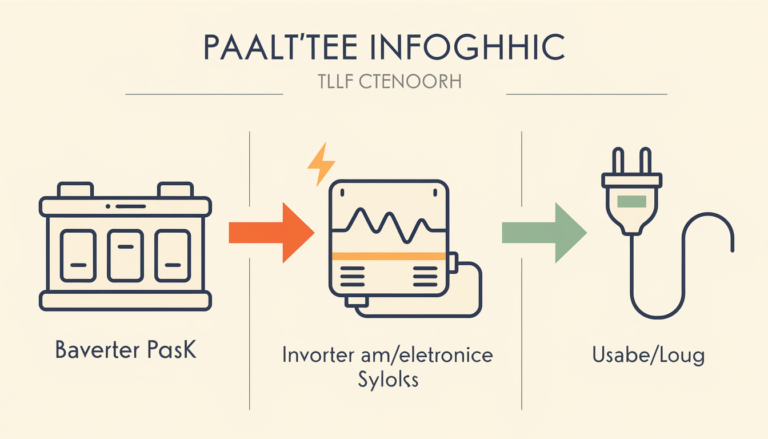
Several mechanisms can contribute to the difference between rated battery energy and energy delivered to a device.
Inverter Conversion
The battery stores DC electricity.
When you use the station's AC outlets, the inverter converts DC electricity into AC electricity.
That conversion is not perfectly efficient, so some energy is lost during the process.
Power Station Self-Consumption
The power station needs energy for its own operation.
Depending on the model and conditions, that can include:
- control electronics;
- display electronics;
- battery-management functions;
- communications hardware;
- inverter operation;
- cooling fans.
Battery Protection and Cutoff Behavior
Battery-management systems control charging and discharging to protect the battery and keep the system operating within defined limits.
A station may therefore stop delivering power before every theoretical unit of stored battery energy could be extracted.
Load Level
Efficiency can vary according to how much power the connected device draws.
A very light AC load can be affected more strongly by the station's fixed inverter and idle consumption.
Higher loads introduce different conversion and thermal behavior.
This is one reason a single usable-capacity percentage should not be assumed to apply to every load.
Output Type
The energy path is not identical for:
- AC outlets;
- USB outputs;
- USB-C;
- DC outputs.
Using the AC inverter can introduce losses that are different from powering a compatible DC or USB device directly.
Temperature and Operating Conditions
Battery behavior and system efficiency can also vary with operating conditions.
Manufacturer-specified temperature limits should therefore be respected when using, charging, or storing a power station.
Is There a Standard Usable-Capacity Percentage?
No single percentage should be treated as universally correct for every portable power station.
You may encounter simplified runtime formulas that assume a fixed efficiency factor. Such formulas can be useful for rough planning, but the factor remains an assumption unless it has been verified for the specific model, output method, and load.
Independent testing shows that real portable power stations can deliver different percentages of their stated battery capacity under test conditions.
That is why our preferred evidence order is:
- Measured usable energy for the exact model under relevant conditions
- Manufacturer information where usable energy is explicitly stated
- Clearly labeled planning assumption
- Never present a generic efficiency percentage as an exact measured result
This prevents false precision.
How Do You Calculate Usable Capacity?
If a reliable test reports both rated and delivered energy, you can calculate usable-capacity percentage as:
For example, suppose an independent test measures:
- Rated capacity: 1,000Wh
- Delivered AC energy: 850Wh
Then:
The measured usable capacity under those test conditions is therefore:
850Wh, or 85% of the rated capacity.
This example demonstrates the calculation method only. It does not mean every 1,000Wh power station delivers 850Wh.
Why Does Usable Capacity Matter for Runtime?
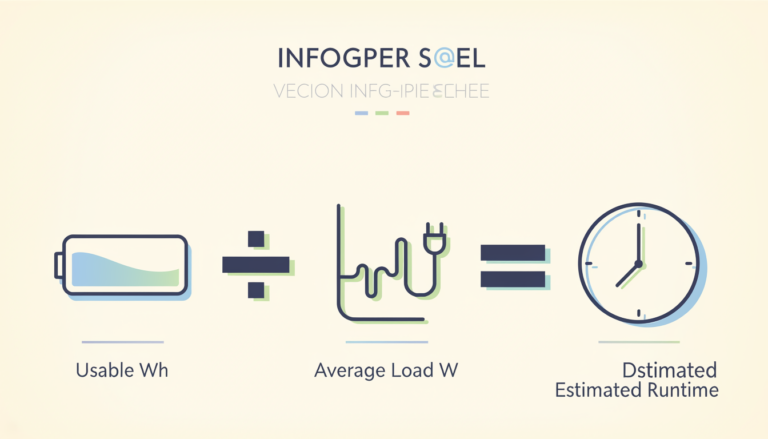
Runtime depends on the energy actually available to the load—not just the number printed on the product.
The basic relationship is:
If a station provides 850Wh of usable energy to a constant 100W load:
If you instead calculated from a 1,000Wh rated battery:
you would overstate the runtime under those assumptions.
This is why using rated capacity alone can produce optimistic estimates.
Rated Runtime vs Real-World Runtime
Theoretical runtime calculations are useful for planning, but they should not be described as guaranteed performance.
A basic calculation may assume:
- constant device wattage;
- known usable energy;
- stable temperature;
- no unexpected system consumption;
- no changing operating modes.
Real appliances frequently behave differently.
For example, a refrigerator may cycle its compressor on and off rather than drawing a constant amount of power.
A laptop can change power consumption according to:
- workload;
- display brightness;
- battery charging;
- processor activity.
A fan may have several speeds.
A CPAP system can consume different amounts of energy depending on its configuration.
Therefore:
Batrefore:
Battery capacity helps estimate runtime, but the load's actual energy consumption is equally important.
Example: Rated Capacity vs Estimated Runtime
Consider a hypothetical portable power station with:
1,000Wh rated battery capacity
and suppose credible testing under the intended output conditions shows:
850Wh usable energy
For a constant 100W load:
Using rated capacity
Using measured usable capacity
The 1.5-hour difference comes from using different energy values in the calculation.
Again, this example is illustrative. Actual usable energy and runtime vary by station and operating conditions.
Does a 1,000Wh Portable Power Station Store 1kWh?
A 1,000Wh rated portable power station has a nominal battery capacity equal to:
because:
That does not mean it will necessarily deliver a full 1kWh of usable AC energy.
The distinction is:
Rated battery capacity
Approximately:
Usable delivered energy
Depends on the station, output path, load, cutoff behavior, and other conditions.
This distinction should always be made when discussing runtime.
How Much Capacity Do You Need?
The capacity you need depends on:
- the devices you are powering;
- their average energy consumption;
- the desired runtime;
- usable-energy assumptions;
- whether you can recharge during use.
The starting formula is:
Then add an appropriate allowance for real-world system losses and uncertainty.
For example, if your combined load averages 200W and must operate for five hours:
A station with exactly 1,000Wh of rated capacity would generally provide little or no allowance for power-system losses under this simplified scenario.
The actual station size should therefore be determined from realistic usable-energy expectations rather than a perfect theoretical conversion.
Capacity Requirements for Multiple Devices
For several devices, calculate the energy used by each device and add the results.
For example:
| Device | Average load | Runtime | Energy |
|---|---|---|---|
| Device A | 100W | 5 h | 500Wh |
| Device B | 50W | 4 h | 200Wh |
| Device C | 20W | 10 h | 200Wh |
| Total | — | — | 900Wh |
The theoretical energy requirement is:
900Wh
You would then account for real-world usable energy when choosing a station.
Remember that this calculation determines capacity.
You must separately confirm that the station's output can support the devices when they operate simultaneously.
Does Higher Capacity Mean Longer Runtime?
All else being equal, more usable battery capacity allows the same load to operate for longer.
For example, if two stations have:
- equivalent output capability;
- equivalent conversion efficiency;
- identical operating conditions;
then the station with twice the usable energy could theoretically support the same constant load for approximately twice as long.
In real products, however, “all else being equal” often does not apply.
Models can differ in:
- inverter efficiency;
- idle consumption;
- cutoff behavior;
- battery design;
- thermal behavior;
- usable reserve.
Capacity remains the major energy variable, but it is not the only runtime variable.
Does Higher Capacity Mean More Power?
No.
A higher-capacity battery does not automatically mean the portable power station provides higher output.
Capacity is measured in:
Wh
Output is measured in:
Consider two hypothetical stations:
Station A
- 2,000Wh capacity
- 1,000W continuous output
Station B
- 1,000Wh capacity
- 1,800W continuous output
Station A stores more energy.
Station B can support a higher continuous power load.
Neither station is universally “more powerful” without defining what you mean.
This is why Power Station Scout avoids using the word powerful when a more precise attribute is available.
Does Battery Chemistry Change Capacity?
Battery chemistry and battery capacity are different attributes.
A portable power station can use:
- LiFePO4;
- another lithium-ion chemistry;
while offering many different capacity sizes.
Chemistry may influence:
- cycle-life specification;
- weight;
- cell voltage;
- thermal characteristics;
- product design.
But a LiFePO4 label does not tell you the battery's capacity by itself.
You still need the watt-hour specification.
Does Battery Age Reduce Usable Capacity?
Rechargeable batteries gradually lose some ability to store energy as they age and accumulate cycles.
Manufacturers commonly express battery longevity using a cycle-life specification tied to a remaining-capacity threshold.
For example, a specification may state that the battery is expected to retain a defined percentage of original capacity after a particular number of cycles under stated conditions.
That does not mean the battery suddenly stops working at the specified cycle count.
It means the battery's energy-storage capability changes over long-term use.
As capacity declines, runtime for the same load can also decline.
Can You Increase Portable Power Station Capacity?
Some portable power stations support expansion batteries.
An expansion system can increase total stored energy without replacing the main unit.
This may be useful for:
- longer home backup;
- multi-day outages;
- RV use;
- greater off-grid runtime.
However, expansion compatibility is model-specific.
Do not assume:
- every power station accepts expansion batteries;
- all batteries from one brand are interchangeable;
- a battery designed for one generation works with another.
Verify compatibility for the exact product and expansion battery.
Capacity vs Weight
Higher battery capacity usually involves more battery cells and often increases product weight and physical size.
That creates a tradeoff:
more energy
vs
greater portability
For home backup, higher capacity may be more important than carrying comfort.
For camping, photography, or frequent vehicle loading, a lighter station may be more practical.
This is why capacity should not be maximized without considering the use case.
The goal is not:
Get the most watt-hours possible.
The goal is:
Get enough usable energy for the required runtime at an acceptable weight, size, and price.
Capacity vs Price
Higher capacity usually increases product cost, but battery size alone does not determine value.
Two similarly rated stations can differ in:
- output;
- battery chemistry;
- usable energy;
- charging performance;
- weight;
- ports;
- UPS/EPS capability;
- expandability;
- warranty.
A capacity-to-price calculation can help compare products, but it should not become the sole decision criterion.
A cheaper cost per Wh is poor value if the product does not satisfy the required output or use case.
Should You Buy More Capacity Than You Need?
Some additional capacity can provide useful flexibility.
Reasons include:
- uncertain appliance consumption;
- longer-than-expected outages;
- future devices;
- battery aging;
- limited charging opportunities.
But unnecessary oversizing has tradeoffs:
- higher purchase price;
- more weight;
- more storage space;
- potentially longer recharge requirements.
There is no universal percentage by which everyone should oversize.
The appropriate margin depends on the reliability and importance of the load.
Capacity for Refrigerator Backup
For refrigerator backup, capacity affects how long the refrigerator can operate, but output and startup capability determine whether the station can support the load in the first place.
The sizing process should therefore consider:
- running power;
- startup demand;
- average energy consumption;
- desired backup time;
- usable battery energy.
Do not choose a refrigerator backup station by Wh alone.
Capacity for Camping
Camping capacity depends on:
- device list;
- energy consumed per day;
- trip duration;
- access to vehicle charging;
- solar charging availability;
- acceptable station weight.
If you can reliably recharge each day, you may need less stored capacity than someone who must carry all required energy from the beginning of the trip.
Capacity for Home Backup
Home-backup requirements can become large because several essential loads may need to operate over an uncertain period.
Rather than trying to size a station for the entire home, first define essential loads such as:
- refrigeration;
- internet equipment;
- lights;
- communications;
- selected electronics;
- other required devices.
Then calculate their energy consumption over the desired backup period.
Expandable capacity may become particularly relevant when longer backup time is required.
Common Portable Power Station Capacity Mistakes
Treating Wh as watts
Watt-hours measure energy. Watts measure power.
Assuming rated capacity equals delivered energy
Real-world usable energy can be lower.
Using one universal efficiency percentage
Usable-energy percentage varies by model and test conditions.
Ignoring the load's actual consumption
Capacity only becomes useful when connected to a load and runtime.
Ignoring inverter output
A large battery does not guarantee compatibility with a high-power appliance.
Using maximum device wattage as average consumption
Cycling and variable loads may consume less energy over time than their maximum wattage suggests.
Believing higher capacity is always better
More capacity also affects price, weight, size, and portability.
Presenting calculated runtime as tested runtime
A formula produces an estimate, not a measurement.
Portable Power Station Capacity Checklist
When comparing capacity, verify:
Battery specification
- Rated capacity in Wh
- Exact product/model generation
- Battery chemistry
- Expansion capability
Real-world energy
- Independent usable-capacity test available?
- Test output method identified?
- Test load identified?
- Measured result kept separate from manufacturer rating?
Your requirement
- Average device wattage known
- Required runtime known
- Total theoretical energy calculated
- Conversion/system losses considered
- Appropriate operating margin considered
Other product requirements
- Continuous output sufficient
- Surge capability sufficient
- Weight acceptable
- Charging speed acceptable
- Price/value acceptable
The Bottom Line
Portable power station capacity tells you how much electrical energy the battery is rated to store.
The most important distinctions are:
Watts = power
Watt-hours = energy
Rated capacity = manufacturer battery specification
Usable capacity = energy actually available to the load under particular conditions
The usable energy available through a portable power station can be lower than its headline battery rating because the system consumes energy and power conversion is not perfectly efficient.
For realistic sizing:
1. Determine the load.
2. Determine the desired runtime.
3. Calculate the theoretical energy requirement.
4. Account for usable rather than purely rated capacity.
5. Separately verify continuous and startup output.
Capacity is therefore not a product-ranking number by itself.
The right amount of capacity is the amount of usable energy required to support your actual load for the amount of time you need, while still meeting your portability, charging, and budget requirements.
Related sizing and battery guides
Continue with Rated vs Usable Portable Power Station Capacity, Running Watts vs Starting Watts, or the main portable power station sizing guide.
Size from the load, not the label
Once you know your required usable energy and output, compare only portable power stations that satisfy both requirements.