
How to Store a Portable Power Station
To store a portable power station correctly, power it down, disconnect loads and charging cables, keep it in a cool and dry location, avoid leaving the battery deeply discharged, and follow the exact manufacturer's recommended storage state of charge and maintenance interval.
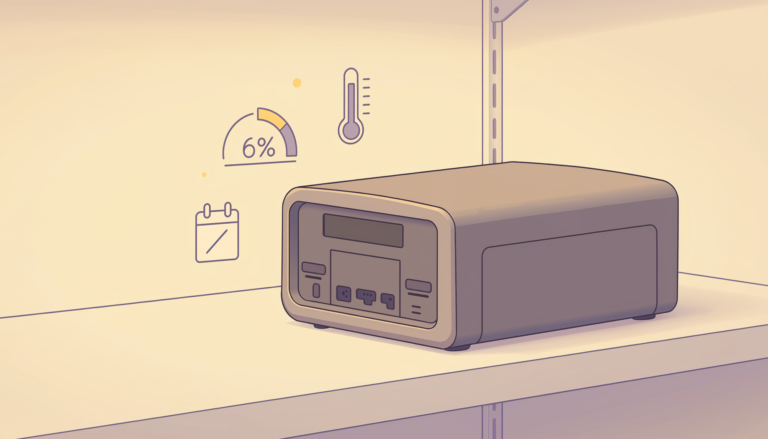
The storage rule that matters most: follow the exact model manual
Current manufacturer instructions vary substantially:
- Jackery currently recommends storing many of its portable power stations with the battery above roughly 80% and checking them about every three months.
- EcoFlow RIVER 3 and several DELTA models currently instruct owners to periodically fully charge the unit and then discharge it to 60% for continued storage.
- BLUETTI AC70P currently recommends 40–60% state of charge before storage, powering the unit off, and disconnecting electrical connections.
- BLUETTI B300K currently gives different instructions depending on storage duration, including 60–80% before ordinary storage and 40–60% for storage over six months.
That variation creates the most important storage rule:
A good general process is:
Why Proper Storage Matters
A portable power station can remain unused for:
- weeks;
- months;
- an entire camping off-season;
- between power outages;
- during RV storage;
- as emergency backup.
Even while switched off, the battery system does not become completely inactive.
Over time:
- battery self-discharge occurs;
- internal electronics can consume small amounts of energy;
- temperature affects calendar aging;
- excessive humidity can damage equipment;
- an already-low battery can drift into deep discharge.
Long-term storage therefore affects both:
battery health
and:
emergency readiness.
The Most Important Storage Rules
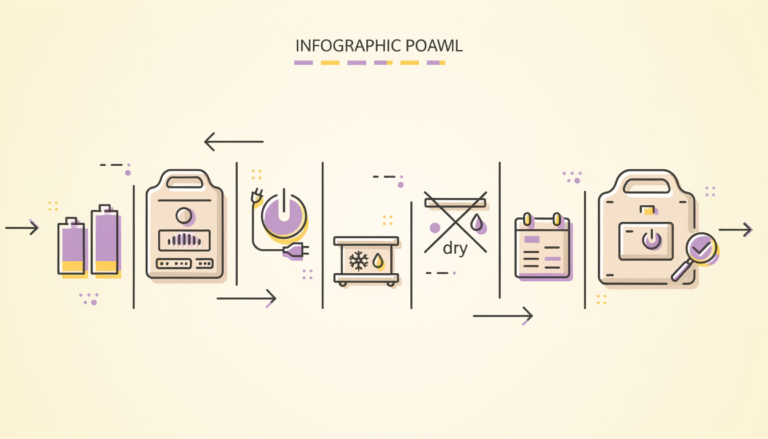
For most portable power stations:
- Do not put the unit away at or near 0% unless the manufacturer specifically instructs otherwise as part of a maintenance cycle.
- Use the manufacturer's storage state-of-charge recommendation.
- Power the station off when long-term storage instructions call for it.
- Disconnect chargers, appliances, and accessories.
- Keep the station cool and dry.
- Avoid prolonged storage in a hot vehicle.
- Check the battery periodically.
- Recharge according to the manufacturer's maintenance schedule.
- Check for recalls before bringing a long-stored unit back into service.
What Percentage Should You Store a Portable Power Station At?
There is no single correct percentage for every model.
This is one of the areas where portable power station advice is frequently oversimplified.
Current Manufacturer Examples
| Manufacturer / Product | Current Long-Term Storage Guidance |
|---|---|
| Jackery general PPS guidance | Keep battery above approximately 80%; check about every 3 months |
| EcoFlow RIVER 3 | Fully charge, then discharge to 60% every 3 months |
| EcoFlow DELTA 3 Classic | Fully charge, then discharge to 60% every 3 months |
| BLUETTI AC70P | Store at 40–60% SOC |
| BLUETTI B300K | 60–80% before storage; 40–60% for storage over 6 months |
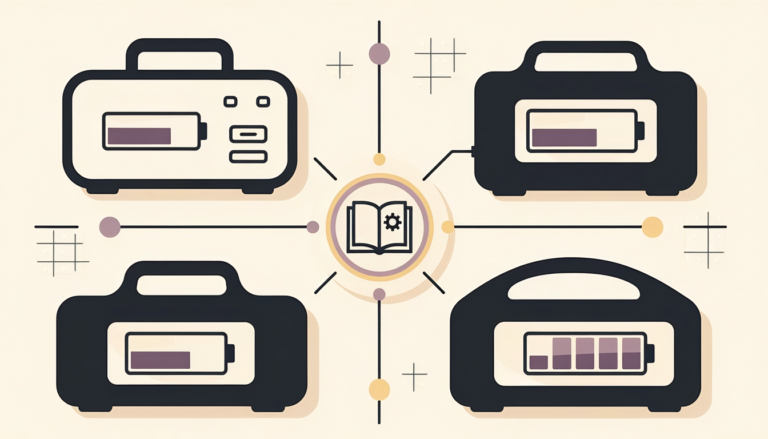
These differences show why:
Do not assume one manufacturer's procedure applies to another.
Is 50% the Best Storage Charge?
Not universally.
Many lithium-ion cell studies show that storage conditions such as:
- temperature;
- state of charge
influence calendar aging.
A 2024 study of commercial lithium-ion cells found storage temperature had a significant influence and that cells stored around 50% SOC showed lower capacity loss than fully charged cells under the tested laboratory conditions. Broader battery-aging literature also identifies high temperature and high state of charge as important calendar-aging drivers.
However, a portable power station is not just a bare battery cell.
It also contains:
- BMS electronics;
- standby consumption;
- display/control circuits;
- product-specific reserve behavior.
That is why a manufacturer may recommend:
- 60%;
- 80%;
- another range
rather than a generic cell-level rule.
Use scientific aging principles to understand why storage SOC matters, but use the exact product documentation to determine what percentage to store the power station at.
Should You Store a Portable Power Station Fully Charged?
Sometimes—for emergency readiness.
But long-term battery longevity and emergency preparedness can point in different directions.
If the unit is stored primarily as:
emergency backup
then having more available energy may be important.
If the unit is stored for:
many months with no expected use
the manufacturer may specify a lower state of charge.
Therefore:
The ideal storage strategy depends on both manufacturer guidance and the reason the station is being stored.
Do not reduce the decision to:
100% is always bad
or:
100% is always best.
Emergency Readiness vs Battery Longevity

Consider two different owners.
Owner A — Emergency Backup
The power station may be needed tonight during:
- storms;
- grid outages;
- wildfire shutoffs;
- severe weather.
For this person, stored energy availability is highly valuable.
A manufacturer-supported higher storage level may make sense.
Owner B — Seasonal Camping Storage
The station will not be used for:
six months
and can be checked periodically.
A manufacturer-recommended partial SOC may prioritize long-term battery health.
The same product can therefore be managed differently depending on:
- use case;
- manufacturer controls;
- expected readiness requirement.
Should You Store a Portable Power Station at 0%?
Generally, avoid prolonged storage at or near empty unless the manufacturer specifically tells you to temporarily discharge to 0% as part of a maintenance cycle.
Current Jackery guidance explicitly warns against long-term storage at 0%, noting that extended full discharge can make the battery difficult or impossible to recharge.
BLUETTI instructions likewise tell owners to recharge promptly when certain products reach very low SOC.
This happens because:
The displayed 0% does not necessarily mean every electronic circuit inside the unit instantly stops consuming all energy.
Over a long period, further self-discharge can push the pack toward deeper discharge.
What Is Deep Discharge?
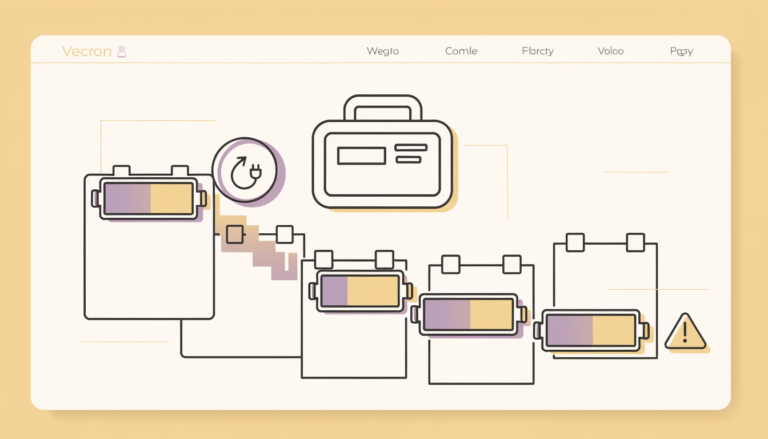
Deep discharge occurs when battery voltage falls below the intended operating range.
The BMS normally prevents ordinary user operation from intentionally discharging cells too far.
But long-term storage adds another factor:
time.
A station stored at very low SOC can continue losing small amounts of charge through:
- self-discharge;
- standby electronics.
If it remains there long enough, the battery can become difficult to recover.
Some manufacturers call the resulting protection state:
deep sleep.
What Is Deep Sleep Mode?
Some battery systems enter a low-power protection state after remaining at very low charge for a long period.
EcoFlow currently notes that a severely depleted battery left idle for too long can enter deep sleep protection mode, requiring charging before normal use resumes.
Deep sleep should not be confused with:
normal storage mode.
The goal is generally to avoid allowing the battery to become severely depleted in the first place.
Does a Portable Power Station Lose Charge While Turned Off?
Yes.
Rechargeable batteries naturally self-discharge over time, and the complete power station may also have low-level electronic consumption.
Current Jackery support, for example, states that its Plus and V2 product families may lose roughly 5% per month under its stated guidance, while its Pro series may lose about 5–10% per month.
Those percentages should not be generalized to other brands.
Self-discharge depends on:
- exact battery system;
- firmware;
- storage temperature;
- enabled features;
- product architecture.
How Often Should You Check a Stored Power Station?
Follow the exact manufacturer schedule.
A common interval among current manufacturers is:
about every three months.
Examples:
- Jackery currently recommends checking its stored units approximately every three months.
- EcoFlow RIVER 3 and DELTA 3 Classic currently specify a three-month storage-maintenance cycle.
- BLUETTI AC70P currently recommends a full cycle every three months.
But some products specify different intervals.
For example, BLUETTI B300K distinguishes ordinary storage from periods longer than six months.
Do not turn:
every three months
into an immutable category-wide rule.
What Should You Do During a Storage Check?
Use the exact product instructions, but a general inspection can include:
- Check the external condition.
- Look for swelling or deformation.
- Inspect ports and cables.
- Power the unit on.
- Check battery percentage.
- Check for abnormal warnings.
- Recharge or cycle it according to the manual.
- Return it to the recommended storage SOC.
- Power it back down if long-term storage continues.
If the battery has fallen much faster than expected, investigate before returning it to storage.
Do You Need to Fully Cycle the Battery During Storage?
Some manufacturers explicitly recommend it.
For example:
- EcoFlow's current storage guidance for several models instructs users to fully charge the product and then discharge it to 60% every three months.
- BLUETTI AC70P recommends fully cycling the product every three months.
- BLUETTI B300K specifies cycling intervals that vary with storage duration.
But this is a manufacturer maintenance procedure, not proof that all lithium-ion batteries benefit from deliberate deep cycling.
Do not extrapolate:
“You must always discharge a lithium battery to 0% every three months.”
Use the exact maintenance procedure for the exact station.
Does Battery Calibration Require Deep Discharge?
Not necessarily.
A deliberate full discharge can sometimes be part of a manufacturer procedure intended to:
- recalibrate displayed state of charge;
- maintain BMS estimation accuracy.
That does not mean deep discharge:
- restores lost battery capacity;
- rejuvenates degraded cells.
Calibration affects the system's estimate of remaining energy.
It does not reverse chemical battery aging.
Should You Power the Station Off for Storage?
Usually yes for long-term storage when the manufacturer instructs it.
BLUETTI AC70P, for example, explicitly tells users to power the unit off and disconnect all electrical connections before storing it.
For other models, use the exact procedure.
Turning off unused outputs helps reduce unnecessary standby drain.
Disconnect Everything Before Long-Term Storage
Unless the manufacturer specifically requires another configuration, disconnect:
- AC appliances;
- USB devices;
- DC loads;
- solar panels;
- wall chargers;
- vehicle chargers;
- external adapters.
Why?
Because connected equipment can:
- consume standby power;
- create an unintended load;
- create unnecessary cable stress.
Expansion batteries are more product-specific.
Follow the exact manufacturer's storage procedure for connected battery modules.
Should You Leave the Charger Connected During Storage?
Do not assume continuous charging is the same as proper storage.
Some portable power stations are designed for:
- UPS;
- EPS;
- always-connected backup.
Others are being stored:
unused.
Those are different operating states.
If the unit is being maintained as an active backup system, follow:
- charge ceiling;
- reserve;
- UPS/EPS;
- continuous-operation
instructions.
If it is being placed into true long-term storage, follow the product's storage procedure instead.
What Is the Best Temperature for Storage?
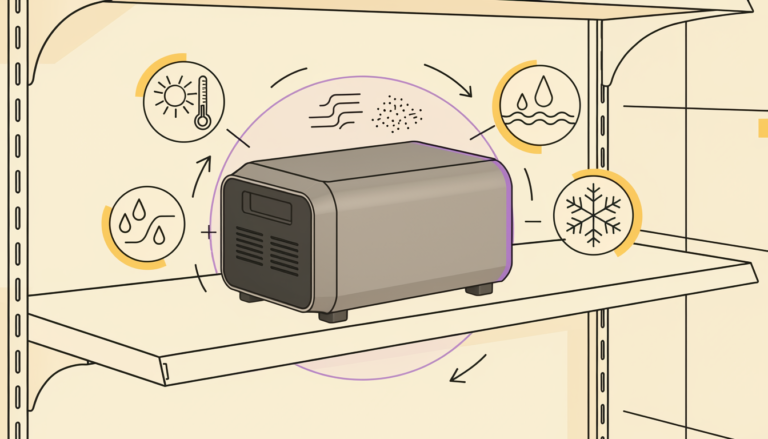
A cool, moderate environment is generally preferable.
Exact ranges vary by product.
Current examples include:
- EcoFlow RIVER 3: storage allowed approximately -10°C to 45°C, with 0°C to 30°C recommended for battery health.
- EcoFlow DELTA 3 Plus: optimal storage approximately 20°C to 30°C.
- BLUETTI AC70P: safe storage approximately -20°C to 40°C, with narrower long-term recommendations.
- Jackery's current general guidance recommends cool, dry storage and lists product-specific temperature requirements.
The important distinction is:
Absolute Storage Range
The product may tolerate this temperature.
Preferred Long-Term Storage Range
A narrower range may be recommended for battery health.
Do not treat the absolute limit as the ideal condition.
Why Heat Is a Problem During Storage
Temperature is one of the strongest drivers of lithium-ion calendar aging.
Battery-aging research consistently shows that elevated temperature can accelerate:
- side reactions;
- capacity loss;
- resistance growth.
High state of charge combined with high temperature can be particularly stressful for many lithium-ion chemistries.
Therefore:
Avoid unnecessary prolonged storage in hot environments even when the temperature has not yet reached the product's absolute safety limit.
Can You Store a Portable Power Station in a Hot Car?
Avoid prolonged storage in a parked hot vehicle.
Current Jackery storage guidance specifically warns against long-term vehicle storage because interior temperatures during summer can exceed recommended storage conditions.
A car cabin or trunk can become much hotter than outdoor ambient temperature.
That can accelerate battery aging and potentially move the product beyond its storage specification.
Can You Leave a Power Station in the Car for a Camping Trip?
Transporting the station in a vehicle is normal.
The concern is prolonged extreme temperature exposure.
When traveling:
- secure the station;
- avoid leaving it in a closed vehicle under strong sun for unnecessarily long periods;
- keep it within the model's temperature limits.
A one-hour drive is not the same scenario as:
months of storage inside a parked vehicle.
Can You Store a Portable Power Station in a Garage?
Potentially.
A garage can be suitable if it remains:
- dry;
- within the product's storage temperature range;
- away from flammable or explosive environments.
But unconditioned garages can become:
- extremely hot in summer;
- very cold in winter;
- humid.
For long-term storage, a temperature-controlled indoor location is often more predictable.
Can You Store It in a Shed?
Potentially, but sheds often experience greater temperature extremes than homes.
Check:
- summer maximum;
- winter minimum;
- moisture;
- condensation.
A dry shed in a mild climate may be acceptable.
A metal shed exposed to intense summer sun may not be.
Can You Store a Portable Power Station in a Basement?
Yes, when the basement is:
- dry;
- protected from flooding;
- within the storage temperature range.
Do not store a high-energy battery station:
- directly beside a sump pit;
- on a floor that regularly floods;
- beneath leaking plumbing.
If flooding is possible, elevate it appropriately without creating an unstable setup.
Can You Store a Power Station in a Closet?
Potentially for storage when:
- the station is powered off;
- the environment remains dry;
- temperature stays within limits.
Keep it away from:
- heaters;
- flammable liquids;
- wet cleaning products.
Do not bury it beneath heavy objects.
And remember:
safe storage in a closet
does not automatically mean:
safe high-power operation in a closed closet.
Ventilation becomes more important when operating or charging.
Can You Store It Under a Bed?
A better location is one where the station can be:
- inspected easily;
- protected from impact;
- kept dry;
- kept away from combustible clutter.
Under-bed storage can make routine inspection easier to forget and may expose the unit to:
- dust;
- blocked access;
- accidental physical impact.
If used, ensure the station is actually within its environmental requirements and is not crushed by stored objects.
Does Humidity Matter?
Yes.
Portable power stations contain electrical circuits and connectors.
Long-term exposure to excessive humidity can contribute to:
- corrosion;
- moisture problems.
Jackery's current storage guidance recommends protection from high humidity and notes that its products are not fully waterproof or dustproof.
Store the station in a:
cool, dry location.
What About Condensation?
Condensation can occur when a cold station is moved suddenly into warm, humid air.
Moisture can form:
- externally;
- potentially around connectors or internal surfaces.
If a station has been stored in severe cold, allow it to acclimate in a dry environment before charging or operating it.
Do not immediately connect high-power charging while visible condensation is present.
Should You Store a Power Station in Its Original Box?
The original box can protect against:
- dust;
- scratches;
- accidental bumps.
But packaging should not create:
- moisture trapping;
- extreme heat.
If using the original box:
- ensure the station is dry;
- store the box in a dry environment;
- do not stack excessive weight on it.
The manufacturer's hard case or storage bag can also be useful when intended for storage.
Should You Store Cables With the Power Station?
Yes, keeping compatible cables nearby can improve emergency readiness.
Organize:
- AC charging cable;
- solar adapter;
- vehicle cable;
- other required accessories.
But do not leave heavy cables:
- pulling on ports;
- tightly bent around connectors.
Disconnect them unless the manufacturer says otherwise.
Protect the Ports During Storage
Keep connectors:
- clean;
- dry;
- free from metal objects.
Use manufacturer port covers when provided.
Do not insert:
- foil;
- metal;
- improvised plugs
into open ports.
The goal is to prevent:
- dust;
- debris;
- accidental short circuits.
Should You Clean the Power Station Before Storage?
If needed, use the manufacturer's cleaning procedure.
For example, EcoFlow and BLUETTI commonly specify cleaning external surfaces with a:
soft, dry cloth.
Do not spray:
- cleaner;
- water
directly into:
- vents;
- outlets;
- charging ports.
Inspect the Station Before Putting It Away
Check for:
- swollen enclosure;
- cracks;
- loose handles;
- burned outlets;
- melted charging ports;
- corrosion;
- damaged cables;
- unusual odor.
Do not put a visibly damaged station into storage and assume the problem can be investigated months later.
What If the Power Station Was Dropped Before Storage?
If it suffered a severe impact, follow the manufacturer inspection or service procedure before long-term storage.
Internal damage can remain hidden.
Do not store a potentially damaged lithium battery:
- inside a living area;
- beside combustible materials
without first resolving the condition.
What If the Battery Is Swollen?
Do not place a swollen unit into normal storage.
Stop:
- charging;
- using.
Do not:
- puncture;
- compress;
- open
the enclosure.
Follow manufacturer and appropriate battery-disposal guidance.
Check Recall Status Before Storage
A recall may require:
- stopping use;
- firmware repair;
- replacement;
- another remedy.
If the station will be stored as emergency equipment, unresolved recall status is especially important because the product may later be used under stressful outage conditions.
Check:
- exact brand;
- exact model;
- exact model number;
- current CPSC information.
Check Recall Status Again Before Reuse
A station can be placed into storage with no known recall and become subject to a recall months later.
Before returning an older station to active use:
- identify exact model;
- check current CPSC recall information;
- check manufacturer support;
- complete any remedy.
Storage is not a reason to assume safety information remained unchanged.
How to Store a Portable Power Station for Emergency Backup
Emergency storage has one unusual requirement:
the battery needs to be ready when the emergency happens.
That creates a tradeoff.
Maximum longevity might favor:
- moderate SOC;
- less time near full charge.
Maximum readiness favors:
- more available stored energy.
A practical approach is:
- follow manufacturer storage guidance;
- use supported charge ceilings or battery-saving modes where appropriate;
- periodically check battery state;
- charge closer to full before a known severe-weather event.
Some current Jackery products, for example, provide a Battery Saving Mode that limits operation to approximately 15–85% for long-term battery-life priorities.
That is a product feature—not a universal storage range.
Should You Charge to 100% Before a Storm?
If an outage is expected soon, maximizing available backup energy can be more valuable than optimizing long-term storage SOC.
For example:
normal routine
→ manufacturer-supported battery-saving/storage setting.
major storm forecast
→ charge closer to full for emergency readiness.
Once the emergency passes, return to the appropriate long-term operating or storage strategy.
Battery longevity is important.
So is having enough energy during an actual outage.
How to Store a Power Station for Camping Off-Season
For seasonal storage:
- clean and inspect the unit;
- follow the exact storage SOC recommendation;
- power it off;
- disconnect cables;
- store it somewhere dry and moderate;
- add a calendar reminder for the next manufacturer-required check;
- recharge/cycle as instructed.
Before the next trip:
- inspect it;
- check recall status;
- charge it;
- test the outputs.
How to Store a Power Station in an RV
If the RV will experience:
- freezing winters;
- extreme summer heat;
consider removing the power station and storing it in a more moderate environment.
External RV compartments can become:
- much colder;
- much hotter
than occupied interior space.
Also protect the unit from:
- condensation;
- movement;
- rodents chewing cables.
Can You Leave a Power Station Permanently in an RV?
Potentially if the exact product and installation support it.
But permanent installation differs from long-term inactive storage.
Consider:
- temperature;
- ventilation;
- charging source;
- solar;
- vibration;
- battery reserve.
Follow product-specific RV integration guidance.
How to Store Expansion Batteries
Use the instructions for the exact expansion battery.
Do not assume the main station's storage procedure automatically applies.
Current EcoFlow DELTA Pro 3 Smart Extra Battery guidance, for example, provides its own storage range and periodic maintenance procedure.
BLUETTI B300K likewise has storage instructions specific to the battery module.
Record storage instructions separately for:
- main power station;
- expansion batteries.
Should Expansion Batteries Be Disconnected?
This is model-specific.
Some battery systems are intended to:
- remain connected.
Others may have a shutdown/disconnection procedure for long-term storage.
Do not disconnect high-current battery cables while energized unless the product instructions permit it.
Follow:
- shutdown sequence;
- cable locking procedure;
- storage SOC
for the exact battery ecosystem.
Can You Store Solar Panels Connected?
For true long-term storage, normally disconnect charging equipment unless the system is specifically designed for permanent solar maintenance.
A portable folding solar panel left permanently connected may create:
- unnecessary cable exposure;
- outdoor weathering;
- unintended charging behavior.
Fixed home-backup systems are different.
Follow the exact system architecture.
Can Solar Maintain a Stored Power Station Automatically?
Some larger energy-storage systems can manage ongoing solar input.
A standard portable power station in inactive storage should not automatically be treated like a solar trickle-charged lead-acid battery.
Lithium battery charging is controlled by the station's electronics.
Use manufacturer-supported:
- solar;
- charge ceiling;
- standby mode
if continuous energy maintenance is desired.
How to Bring a Stored Power Station Back Into Service
Before immediately connecting your largest appliance:
- Inspect the enclosure.
- Inspect ports and cables.
- Check for recalls.
- Allow the station to reach an appropriate operating temperature.
- Power it on.
- Check battery percentage.
- Check the display for warnings.
- Charge according to the manual.
- Test a modest load.
- Then return it to normal service.
This is particularly important after:
- many months of storage;
- extreme temperatures;
- unknown storage conditions.
Should You Fully Charge After Storage?
Often, yes before normal use—especially when you need the full battery capacity.
But some manufacturers may specify a maintenance cycle before reuse.
For example, BLUETTI B300K guidance recommends a cycle charge before reuse after certain long-term storage conditions.
Follow the exact manual.
What If the Power Station Will Not Turn On After Storage?
Possible causes include:
- battery deeply discharged;
- BMS protection state;
- temperature outside operating range;
- hardware issue.
Start with:
- move it into an appropriate temperature range;
- connect the correct charging source;
- follow the manufacturer's wake-up procedure.
Do not repeatedly open or modify the unit.
If it still fails, move to the dedicated charging-troubleshooting workflow.
What If It Shows 0% After Storage?
Do not leave it there.
Use the manufacturer recovery procedure.
BLUETTI currently instructs users of several products that reach 0% to:
- shut down promptly;
- recharge within a specified period;
- allow the battery to reach an appropriate ambient temperature before charging.
Exact recovery procedures differ.
Why Does the Battery Drain in Storage?
Possible reasons include:
- natural self-discharge;
- enabled outputs;
- standby electronics;
- connected devices;
- extreme temperature;
- battery aging.
If storage drain is much greater than expected, the dedicated battery-drain troubleshooting article should own the diagnostic process.
Does Storage Count as Battery Aging?
Yes.
Lithium-ion batteries age even when they are not being cycled.
This is called:
calendar aging.
Calendar aging is affected by:
- time;
- temperature;
- state of charge;
- battery chemistry.
That is why a battery can lose capacity even if it has accumulated very few charge cycles.
Is Cycle Life More Important Than Storage Conditions?
They describe different mechanisms.
Cycle Life
Battery degradation associated with repeated charge/discharge throughput.
Calendar Life
Battery degradation that happens with time even while mostly unused.
A power station kept for emergency backup may experience relatively little cycling while still experiencing calendar aging.
Therefore storage conditions matter even for:
rarely used batteries.
Does LiFePO4 Change Storage Rules?
LFP can have strong long-term cycle-life characteristics, but it does not create a universal storage procedure.
LFP power stations still differ in:
- BMS design;
- self-discharge;
- standby electronics;
- manufacturer strategy.
For example, current EcoFlow and BLUETTI LFP products can still publish different storage SOC instructions.
Is Long-Term Storage at 100% Bad for LiFePO4?
High state of charge can influence calendar aging in lithium-ion batteries, but the effect is chemistry- and temperature-dependent.
Do not turn this into:
Never store LFP at 100%.
Instead:
- follow the exact product's storage guidance;
- avoid unnecessary prolonged high-temperature/high-SOC exposure;
- balance emergency readiness against longevity.
That is more accurate than a universal percentage rule.
Is Long-Term Storage at 20% Better?
Not necessarily.
Very low SOC gives less buffer against:
- self-discharge;
- standby drain.
Recent battery research also shows that low-SOC storage is not simply a linear “lower is always better” problem, particularly when deep-discharge risks are considered.
For a complete power station, manufacturer guidance should override simplistic battery-cell heuristics.
Can You Store a Power Station for a Year?
Yes, if the manufacturer permits it and you perform required maintenance.
Do not interpret:
one-year storage
as:
put it on a shelf and ignore it for a year.
Many current manufacturers specify periodic:
- checks;
- charging;
- cycling.
Some also link maintenance intervals to warranty conditions. EcoFlow currently states for several products that leaving them uncharged or unused beyond specified periods can affect warranty coverage.
Can You Store It for Several Years?
Potentially, but performance will age over time even without heavy use.
For multi-year ownership:
- maintain SOC;
- maintain temperature;
- check recall status;
- periodically test functionality.
Eventually the battery will lose some capacity through:
- calendar aging;
- cycling.
Long storage does not freeze the battery at its original health.
Portable Power Station Storage Checklist
Before Storage
- Exact model identified
- Manual checked
- Recall status checked
- Storage SOC verified
- Unit visually inspected
- No swelling
- No water damage
- No melted connectors
- Firmware safety remedy completed if required
Power Down
- AC output off
- DC output off
- USB loads disconnected
- Charging cable disconnected
- Solar disconnected
- Station powered off where required
Storage Location
- Dry
- Cool/moderate
- Within manufacturer temperature range
- Away from direct sunlight
- Away from heaters
- Away from flammable/explosive materials
- Protected from flooding
- Stable and protected from falling
Maintenance
- Next check date recorded
- Battery level checked periodically
- Maintenance cycle completed as instructed
- Storage SOC restored
Before Reuse
- Recall status rechecked
- Battery acclimated to suitable temperature
- Unit inspected
- Battery charged
- Warning display checked
- Basic output test completed
Common Storage Mistakes
Using One Universal Storage Percentage
Manufacturer instructions vary.
Leaving the Battery at 0% for Months
Self-discharge can create deep-discharge problems.
Assuming 100% Is Always Best
Emergency readiness and calendar aging involve different priorities.
Assuming 50% Is Always Best
Cell-level battery-aging advice does not automatically replace product-specific PPS instructions.
Never Checking the Unit
Many manufacturers specify periodic maintenance.
Storing It in a Hot Car
Vehicle temperatures can exceed recommended storage ranges.
Storing It Somewhere Damp
Humidity and electrical equipment are a poor combination.
Leaving Loads Connected
Standby consumption can drain the battery.
Ignoring Expansion-Battery Instructions
Battery modules may have separate storage procedures.
Putting a Damaged Battery Into Storage
Damage should be resolved first.
Forgetting Recalls
Safety status can change during the storage period.
Charging Immediately After Bringing a Frozen Unit Inside
Internal battery temperature can lag behind room temperature.
Frequently Asked Questions
What Percentage Should I Store a Portable Power Station At?
Use the exact manufacturer's recommendation. Current products vary from approximately 40–60% to 60%, 60–80%, or higher manufacturer-recommended storage levels.
Is 50% the Best Storage Level?
Not universally. Mid-level SOC can reduce calendar-aging stress in many lithium-ion cells, but complete portable power stations have product-specific storage instructions.
Can I Store It at 100%?
Potentially if manufacturer guidance and emergency-readiness needs support it. Avoid replacing product-specific guidance with a universal rule.
Should I Store It at 0%?
Generally avoid prolonged storage at very low SOC unless the manufacturer explicitly calls for temporary full discharge as part of a maintenance procedure.
How Often Should I Recharge It in Storage?
Many current products use intervals around three months, but the exact schedule is model-specific.
Should I Turn It Off?
Usually for true long-term storage when the manual says to. Disconnect unnecessary electrical connections.
Does It Lose Charge While Turned Off?
Yes. Batteries self-discharge, and internal electronics may consume small amounts of power.
Can I Store It in a Garage?
Yes if temperature and humidity remain within the product's requirements.
Can I Leave It in My Car?
Avoid long-term storage in a parked hot vehicle.
Can I Store It in a Cold Shed?
Only if the exact storage-temperature specification supports those conditions and the environment remains dry.
Can I Leave It Plugged In?
Some products are designed for continuous UPS/EPS use, but that is not the same as long-term inactive storage.
Should I Disconnect Solar Panels?
For ordinary inactive storage, generally follow the manufacturer's procedure and disconnect external charging sources unless the system is specifically designed for permanent maintenance.
Does LiFePO4 Need Different Storage?
LFP is still lithium-ion battery technology. Follow the exact station's manufacturer instructions rather than assuming one universal LFP storage percentage.
What If the Battery Reaches 0% in Storage?
Follow the manufacturer recovery procedure and recharge promptly rather than leaving it deeply discharged.
Should I Check for Recalls Before Using It Again?
Yes. Recall status can change while the station is stored.
The Bottom Line
The correct way to store a portable power station is:
1. Identify the exact model.
2. Follow its recommended storage state of charge.
3. Avoid prolonged storage near 0%.
4. Power down and disconnect unnecessary equipment.
5. Store the unit somewhere cool, dry, stable, and within its temperature limits.
6. Avoid hot vehicles, moisture, flooding, and direct heat.
7. Check the battery periodically according to the manufacturer.
8. Restore the recommended storage SOC after maintenance.
9. Inspect the station and check current recall status before returning it to use.
The most important semantic distinction is:
There is no universal “best storage percentage” for every portable power station.
Lithium-ion battery research supports avoiding unnecessary high-temperature storage and shows that state of charge affects calendar aging, but portable power station manufacturers currently publish different storage procedures because each system includes its own:
- cells;
- BMS;
- electronics;
- reserve logic;
- self-discharge behavior.
So the correct hierarchy is:
battery-aging principles
→ help explain storage behavior;
but:
exact manufacturer instructions
→ determine the storage procedure for the specific portable power station.
Store the exact model—not a generic battery
Use the manufacturer’s storage SOC, keep the unit cool and dry, schedule periodic checks, and inspect it before returning it to service.
Explore Safety & Care