
What Appliances Can a Portable Power Station Run?
A portable power station can run an appliance when its continuous output, startup capability, output type and usable battery capacity match that specific appliance’s electrical requirements.
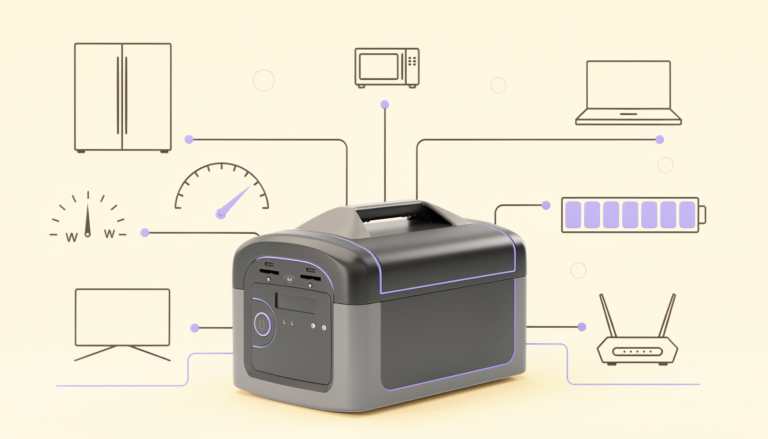
Five checks decide whether the appliance and power station are compatible
A portable power station can run an appliance when the station's power output, startup capability, output type, and battery capacity are compatible with that appliance's electrical requirements.
The appliance category alone does not determine compatibility.
A portable power station may be able to run devices such as:
- phones and tablets;
- laptops;
- Wi-Fi routers and modems;
- televisions;
- lights;
- fans;
- CPAP equipment;
- refrigerators;
- freezers;
- coffee makers;
- microwaves;
- selected power tools;
- other compatible AC, USB, or DC devices.
But the correct question is not simply:
Can a portable power station run a refrigerator, microwave, or coffee maker?
It is:
Does this specific portable power station meet the power and energy requirements of this specific appliance?
To answer that, check five things:
- Running watts
- Starting or surge watts
- Portable power station continuous and surge output
- Required runtime and usable battery capacity
- Voltage, port, and other compatibility requirements
A device being able to plug into a power station does not prove that the station can operate it.
How to Tell Whether a Portable Power Station Can Run an Appliance
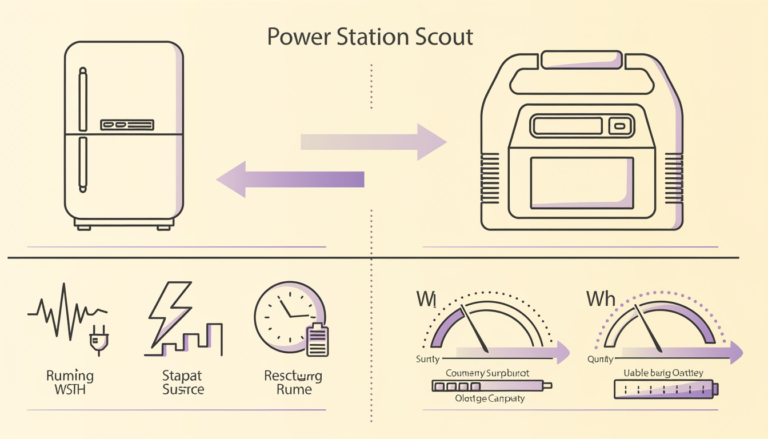
Use this sequence.
Step 1 — Find the Appliance's Running Power
Determine how much power the appliance requires during normal operation.
This is usually expressed in:
Possible sources include:
- appliance nameplate;
- manufacturer manual;
- manufacturer specifications;
- credible electrical measurements.
The station's applicable continuous-output rating must be sufficient for the load.
Step 2 — Check Starting Power
If the appliance contains a:
- compressor;
- motor;
- pump;
it may require temporarily higher power during startup.
The station needs sufficient startup or surge capability for that event.
Step 3 — Consider Other Devices Running at the Same Time
If several appliances operate simultaneously, their loads combine.
A station that can run each device individually may still overload when all of them operate together.
Step 4 — Calculate Required Battery Energy
Once output compatibility is confirmed, determine how long the appliance must run.
A basic theoretical relationship is:
Then account for usable rather than purely rated battery energy.
Step 5 — Verify the Connection
Check that:
- voltage is appropriate;
- the correct output is available;
- the port supports the required power;
- manufacturer limitations are respected.
These five checks determine compatibility more reliably than appliance name alone.
Continuous Output Determines What the Station Can Sustain
Portable power stations typically specify a continuous AC output in watts.
This tells you how much power the station is designed to provide continuously under its stated operating conditions.
Suppose a hypothetical appliance requires:
A station with only:
would be undersized for that load even if its battery contained several thousand watt-hours.
This demonstrates an important rule:
Starting Watts Can Determine Whether an Appliance Will Turn On
Some appliances need more power during startup than during normal operation.
Common examples can include:
- refrigerators;
- freezers;
- pumps;
- motor-driven tools.
A station may therefore have enough continuous output to support the appliance after startup but still be unable to start it.
For those loads, compare:
Appliance startup requirement
with:
Portable power station applicable surge/startup capability
Do not assume every manufacturer's “surge,” “peak,” or “boost” figure has the same definition.
Use the documentation for the exact power station.
Battery Capacity Determines How Long the Appliance Can Run
After confirming that the power station can support the appliance's power requirement, determine whether the battery contains enough energy.
Battery capacity is usually expressed in:
A simplified theoretical calculation is:
For example:
If:
- usable battery energy = 800Wh;
- constant load = 100W;
then:
This is an estimate under those assumptions.
Real-world runtime can change because:
- appliance consumption varies;
- rated capacity is not fully delivered to every load;
- inverter and station electronics consume energy;
- temperature and battery condition matter.
Rated Watt-Hours Do Not Guarantee Appliance Runtime
A power station advertised as:
should not automatically be assumed to supply exactly:
to an AC appliance.
Some energy is consumed within the power station itself.
Therefore, this calculation:
represents a theoretical upper-level calculation, not guaranteed runtime.
For better estimates, use:
- credible measured usable energy for the exact station; or
- a clearly identified planning allowance.
Can a Portable Power Station Run a Refrigerator?
Yes, a portable power station can run a refrigerator when its continuous output can support normal operation, its startup capability can handle the compressor, and its battery provides enough usable energy for the required backup duration.
Refrigerators are more complex than simple constant loads because the compressor cycles.
Important values include:
- running power;
- startup demand;
- average energy consumption;
- desired backup time.
Do not size refrigerator backup from advertised power station capacity alone.
Can a Portable Power Station Run a Freezer?
Yes, when the portable power station meets the freezer's output, startup, and energy requirements.
Like refrigerators, freezers often use compressor-driven systems.
Check:
- running watts;
- startup demand;
- energy consumption over time;
- required backup duration.
Because models vary, exact freezer documentation is preferable to a generic appliance-wattage assumption.
Can a Portable Power Station Run a CPAP Machine?
A portable power station can power compatible CPAP equipment when the station supports the device's electrical requirements and has enough battery energy for the required operating period.
Actual consumption can depend on:
- exact CPAP model;
- power adapter;
- heated humidifier;
- heated tubing;
- operating settings;
- hours of use;
- output method.
For backup calculations, use manufacturer-supported electrical information for the exact CPAP device.
This guide covers electrical compatibility and energy calculations only; it does not provide medical treatment advice.
Can a Portable Power Station Run a Wi-Fi Router and Modem?
Yes, many portable power stations can support compatible routers and modems because networking equipment often has comparatively modest power requirements.
The exact runtime depends on the combined power consumption of:
- router;
- modem;
- optical network terminal or other required networking equipment.
For example, if the complete networking setup averages:
and a station provides:
the simplified estimate is:
The 20W figure is illustrative only.
Use the actual equipment's power requirements for a real backup plan.
Can a Portable Power Station Run a Laptop?
Yes, when the station provides a compatible output for the laptop.
Laptops may be powered through:
- AC charger;
- compatible USB-C output;
- another manufacturer-supported connection.
Laptop power consumption varies according to:
- processor workload;
- display brightness;
- internal battery charging;
- connected peripherals;
- performance mode.
For many laptops, direct USB-C power can be more convenient than using the station's AC inverter when the laptop and power station support an appropriate USB-C power level.
Check the exact laptop charging requirements before assuming compatibility.
Can a Portable Power Station Run a Desktop Computer?
Yes, if the station can support the combined power requirement of the computer and any required peripherals.
A desktop setup may include:
- computer;
- monitor;
- router;
- modem;
- speakers;
- external displays;
- other accessories.
Power consumption can vary significantly between:
- compact office computers;
- workstations;
- gaming systems.
Determine realistic total consumption rather than using one generic “desktop watts” number.
For backup use, also consider whether the power station provides a suitable UPS/EPS-style feature if uninterrupted operation matters.
Can a Portable Power Station Run a Monitor?
Yes, provided the station supports the monitor's electrical requirements.
A monitor is normally a relatively straightforward load compared with a compressor-based appliance because startup surge is usually not the dominant sizing problem.
However, the complete workstation load may include:
- monitor;
- laptop or desktop;
- router;
- modem;
- peripherals.
Size the power station for the complete system that must remain operating.
Can a Portable Power Station Run a TV?
Yes, if the station supports the television's electrical requirements.
TV power consumption varies with:
- screen size;
- display technology;
- brightness;
- picture settings;
- exact model.
The basic runtime formula remains:
For example, with:
- 640Wh usable energy;
- 80W average load;
estimated runtime is:
The 80W input is illustrative rather than a universal TV specification.
Can a Portable Power Station Run Lights?
Yes, compatible lighting can often be powered from a portable power station.
Total energy depends on:
- light power;
- number of lights;
- hours of use.
For example:
Four hypothetical 10W lights create:
If used for five hours:
Low-power lighting can therefore be a relatively manageable backup load, but calculate from the actual lighting equipment.
Can a Portable Power Station Run a Fan?
Yes, if the fan's electrical requirements fall within the station's applicable output limits.
Fan consumption can vary according to:
- size;
- speed setting;
- motor type;
- exact product.
A fan used continuously overnight may consume substantially more total energy than its modest wattage initially suggests because of the long runtime.
Check both:
- output compatibility;
- Wh required over time.
Can a Portable Power Station Run a Microwave?
A portable power station can run a microwave only when it can support the microwave's electrical input power, not merely the cooking-output number displayed in the microwave's marketing.
This distinction matters.
A microwave marketed as:
may use that figure to describe cooking output rather than total electrical input.
The power station needs to support the appliance's actual electrical demand.
Because microwaves are relatively high-power loads, continuous inverter output is particularly important.
They are often used only for a few minutes, however, so their total Wh consumption can be much smaller than an appliance that runs continuously for many hours.
Can a Portable Power Station Run a Coffee Maker?
Yes, if the station has sufficient continuous output for the coffee maker's heating element and other electrical requirements.
Heating appliances can use relatively high power even when they operate for a short duration.
That creates a common pattern:
but potentially:
because the appliance runs only briefly.
Use the exact coffee maker's electrical input.
Can a Portable Power Station Run an Electric Kettle?
Potentially, but electric kettles can be high-power heating loads.
The station's continuous-output rating must meet the kettle's actual electrical input requirement.
Because boiling water may take only a few minutes, energy consumption can be modest relative to the high instantaneous wattage.
For example, an illustrative:
load operating for:
runs for:
and theoretically consumes:
Again, 1,500W is an illustrative input, not a universal kettle specification.
This shows why:
Can a Portable Power Station Run a Toaster?
Potentially.
Toasters are primarily resistive heating loads and can require substantial continuous power during operation.
Check:
- appliance input watts;
- station continuous output.
Because a toaster operates for a relatively short period, runtime is usually less important than whether the inverter can support the instantaneous load.
Can a Portable Power Station Run a Blender?
Potentially, provided the station can support the blender's electrical requirements, including any short-duration startup behavior.
Blenders can use motors and may experience changing load as ingredients are processed.
Use the exact manufacturer's specification where possible.
Can a Portable Power Station Run an Air Fryer?
A sufficiently high-output portable power station may be able to run a compatible air fryer.
Air fryers use heating elements and fans and can be relatively high-power appliances.
The station must provide:
- sufficient continuous output;
- sufficient battery energy for the cooking duration.
Because cooking loads may be high, using them repeatedly can drain a portable battery more quickly than lower-power electronics.
Check the exact appliance's input specification.
Can a Portable Power Station Run a Slow Cooker?
Potentially.
Slow cookers can operate for long periods, so even a modest or moderate wattage can accumulate substantial energy consumption over several hours.
This demonstrates another important principle:
Calculate:
for a meaningful energy estimate.
Can a Portable Power Station Run a Space Heater?
Only a power station with sufficient continuous output can support the electrical input of a compatible space heater, and battery runtime may be relatively short because electric resistance heating can demand substantial continuous power.
For battery backup, heating loads can consume stored energy quickly.
Before attempting to power a space heater:
- check the exact heater input;
- verify power station output;
- follow both products' safety instructions;
- maintain required clearances and ventilation around equipment.
Do not treat a portable power station as permission to ignore heater fire-safety guidance.
Can a Portable Power Station Run a Hair Dryer?
Potentially, but hair dryers can be high-power loads.
Check the appliance's input wattage against the station's continuous output.
The short duration of use can limit total Wh consumption, but the station still needs to supply the high instantaneous power.
This is another case where:
output can matter more than capacity for basic compatibility.
Can a Portable Power Station Run a Washing Machine?
Possibly, depending on the exact machine and power station.
A washing machine can involve:
- motor loads;
- startup behavior;
- pumps;
- electronic controls;
- varying operating stages.
Use exact machine specifications or credible measured demand rather than assuming one universal washing-machine wattage.
The portable power station must support the highest relevant operating demand across the cycle.
Can a Portable Power Station Run a Clothes Dryer?
This depends heavily on the dryer type.
Large electric dryers can require substantially more power than many ordinary portable power stations are designed to provide and may use electrical connections that are not available on smaller stations.
Gas dryers can have different electrical requirements because the heating energy comes from gas while electricity powers other components.
Never assume compatibility from the appliance category alone.
Verify:
- voltage;
- plug type;
- power requirement;
- station output.
Can a Portable Power Station Run an Air Conditioner?
Potentially, but air-conditioning equipment can present challenging loads because of:
- high continuous demand;
- compressor startup;
- long runtime requirements.
Compatibility varies enormously between:
- small portable units;
- window units;
- larger air-conditioning systems.
Check the exact appliance.
A high surge number on the power station does not automatically guarantee compatibility with every air conditioner.
Can a Portable Power Station Run a Furnace?
This question requires careful qualification.
A home furnace can involve:
- blower motor;
- controls;
- ignition system;
- pumps or other components;
- permanent household wiring.
Even if the electrical load appears compatible, safely connecting a portable power station to permanently wired equipment can require an appropriate system design.
Do not improvise a connection to household wiring.
Whole-home and hardwired connection methods require separate guidance from ordinary plug-in appliance use.
Can a Portable Power Station Run a Sump Pump?
Potentially, if the station can support the pump's running and startup power and has enough battery energy for expected operation.
Pumps can have significant startup requirements.
For an emergency sump-pump application, reliability matters more than theoretical compatibility.
Use:
- exact pump requirements;
- exact station specifications;
- realistic cycling expectations;
- an appropriate operating margin.
Can a Portable Power Station Run Power Tools?
Yes, compatible power tools can be run when the station meets their electrical requirements.
Tools can be challenging because motor load may change according to:
- startup;
- mechanical resistance;
- cutting/drilling conditions;
- tool type.
A tool that operates successfully with no load may draw more power during actual work.
For job-site applications, consider:
- continuous power;
- startup demand;
- battery capacity;
- expected duty cycle.
Can a Portable Power Station Charge Cordless Tool Batteries?
Usually, if the tool-battery charger is electrically compatible with the station.
Instead of powering the tool directly, the station supplies the charger's input.
Check:
- charger input watts;
- voltage requirements;
- number of chargers used simultaneously.
This can be a more predictable load than directly operating a corded high-power tool.
Can a Portable Power Station Charge an Electric Bike?
Potentially, by powering the e-bike's compatible charger.
The calculation should use:
- charger input power;
- charging duration;
- energy added to the bike battery;
- conversion losses.
Do not assume the e-bike battery's Wh rating equals the exact amount withdrawn from the portable power station during charging.
Energy passes through multiple conversion stages.
Can a Portable Power Station Charge a Drone?
Yes, when the drone charger is compatible with the station's outputs.
For repeated field charging, calculate total energy across all batteries.
For example:
gives a more useful planning value than looking only at the charger's maximum watts.
Can a Portable Power Station Run Medical Equipment?
Some portable power stations can support compatible medical or accessibility equipment, but the stakes are higher than ordinary consumer-device use.
For these applications, evaluate only:
- published electrical requirements;
- compatible outputs;
- runtime calculations.
For critical medical equipment, users should follow the device manufacturer's instructions and appropriate professional or emergency-preparedness guidance rather than relying solely on a general affiliate guide.
Do not imply medical suitability merely because a device's wattage appears compatible.
Can a Portable Power Station Run Several Appliances at Once?
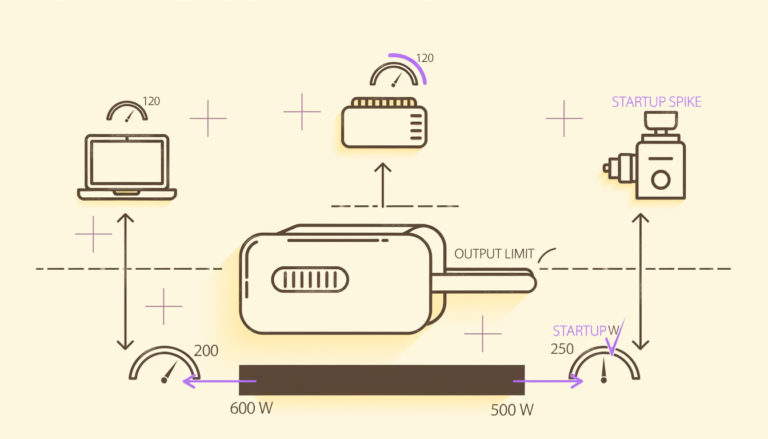
Yes, if the combined load remains within all applicable station limits.
Suppose:
- Device A = 300W
- Device B = 100W
- Device C = 50W
Combined running load:
The station needs sufficient continuous output for the combined 450W load.
If Device A also has a startup demand, the station must handle that temporary event while Devices B and C may already be operating.
Also check whether the station has enough physical outputs for the intended connections.
How Do You Calculate Several Appliances With Different Runtimes?
When devices operate for different durations, calculate energy separately.
Example:
| Device | Average load | Runtime | Energy |
|---|---|---|---|
| Device A | 100W | 5h | 500Wh |
| Device B | 50W | 4h | 200Wh |
| Device C | 20W | 10h | 200Wh |
| Total | — | — | 900Wh |
The theoretical energy requirement is:
Then allow for real-world power-station losses.
Separately, verify the maximum simultaneous power requirement.
This is often the most accurate way to plan a mixed appliance load.
Which Appliances Use the Most Battery Energy?
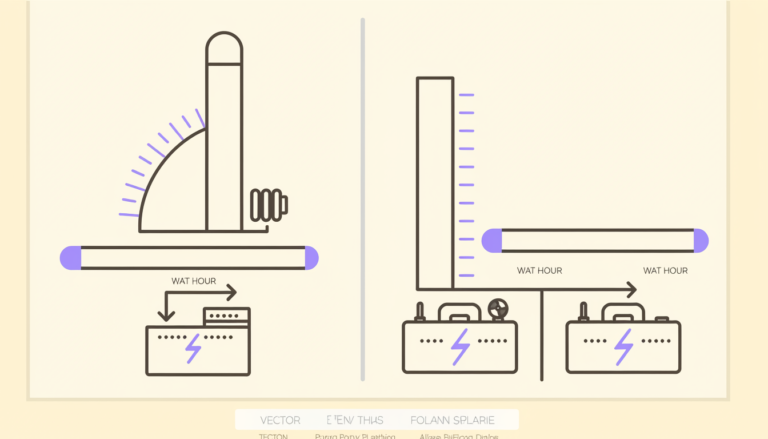
Total battery use depends on:
This means there is no universal list based on watts alone.
A 1,500W appliance used for a few minutes may consume less total battery energy than a 100W appliance running all night.
For example:
High power, short duration
Low power, long duration
So both:
- instantaneous power;
- operating time
matter.
Which Appliances Are Hardest for a Portable Power Station to Run?
Loads can become more demanding for different reasons.
High continuous-power loads
Challenge the station's inverter output.
High-startup loads
Challenge temporary surge capability.
Long-duration loads
Require substantial battery capacity.
Variable/cycling loads
Make runtime prediction more difficult.
Critical loads
Require greater reliability and conservative planning.
Therefore there is no single definition of a “difficult appliance.”
Does the Number of AC Outlets Matter?
Yes, but outlet count should not be confused with total output capability.
A station may have several AC receptacles while still sharing one total inverter limit.
For example, four connected appliances cannot each automatically draw the station's full advertised output.
Check:
- total AC output;
- per-port limitations where applicable;
- simultaneous-load rules.
More outlets provide connection flexibility, not unlimited power.
Does USB-C Wattage Matter?
Yes, when powering compatible laptops, tablets, phones, cameras, or other USB-C devices.
A USB-C port can have its own maximum output.
A laptop requiring a relatively high USB-C charging level may charge slowly or fail to operate as intended from a lower-power port.
Check the power requirements of both:
- device;
- PPS USB-C output.
Does AC Voltage Matter?
Yes.
A U.S.-market appliance is designed for particular electrical conditions, and the portable power station must provide a compatible output.
Do not choose a station from watts alone when:
- voltage differs;
- connector differs;
- frequency or other requirements matter.
For Power Station Scout's U.S. audience, exact U.S.-variant product specifications should be verified before publication.
Pure Sine Wave and Appliance Compatibility
Many modern portable power stations advertise pure sine wave AC output.
For a specific appliance, follow its manufacturer requirements regarding acceptable power source and waveform.
Do not assume universal compatibility solely because a station uses a particular inverter description.
Electrical compatibility includes more than waveform terminology.
Can You Plug a Power Strip Into a Portable Power Station?
A power strip does not increase the station's electrical output.
If used in a manner allowed by the relevant equipment instructions, the total load still must remain within:
- station output limits;
- strip limits;
- individual device requirements.
Do not use additional receptacles as a way to bypass the power station's capacity or output restrictions.
Can You Run Appliances While the Power Station Is Charging?
Some portable power stations support powering loads while accepting charging input.
But this capability varies by model and manufacturer.
Check:
- pass-through operation;
- output restrictions;
- charging limitations;
- UPS/EPS behavior where relevant.
Do not assume every station supports every combination of input and output continuously.
Can Solar Panels Keep an Appliance Running?
Potentially, when solar input contributes enough energy while the station powers the load.
But solar output varies.
A panel rated at:
200W
does not guarantee a constant 200W of charging input throughout the day.
Actual production depends on:
- sun angle;
- cloud cover;
- shading;
- panel temperature;
- panel orientation;
- station input limits.
Solar charging can extend runtime, but the portable power station's battery remains important for periods when solar input is lower than the load.
What Happens If an Appliance Uses Too Many Watts?
If a load exceeds the station's supported output, the station may:
- report overload;
- stop supplying AC power;
- activate protective circuitry;
- fail to start the appliance.
Exact behavior varies by product.
Do not repeatedly attempt to operate a known unsupported appliance.
Follow the manufacturer's operating instructions.
Is It Safe to Run Appliances From a Portable Power Station Indoors?
Battery-powered portable power stations do not use a gasoline engine to generate electricity during normal battery operation, so they do not create the same combustion-exhaust carbon-monoxide hazard as fuel-burning portable generators.
However, that does not mean every portable power station is risk-free.
High-energy batteries can present hazards such as:
- overheating;
- fire;
- electrical problems;
- damaged-cell risks.
Use the station according to its manual and check current safety or recall information for the exact product.
For appliances that create their own hazards—such as portable heaters—the appliance's normal safety rules still apply.
Appliance Compatibility Checklist
Before connecting an appliance, verify:
Appliance
- Exact device identified
- Electrical input known
- Running watts known
- Starting watts known where relevant
- Voltage/connection requirements known
- Expected runtime known
Power station
- Continuous output sufficient
- Surge/startup capability sufficient
- Correct output port available
- Battery capacity sufficient
- Usable energy considered
- Manufacturer restrictions checked
Combined system
- Other simultaneous loads included
- Startup overlap considered
- Estimated runtime calculated
- Charging opportunities considered
- Safety requirements followed
If any critical value is unknown, resolve it before assuming compatibility.
Common Appliance Compatibility Mistakes
Looking only at battery capacity
Wh does not determine whether the inverter can support the appliance.
Looking only at continuous watts
Startup demand may also matter.
Using generic appliance wattage tables as exact data
The exact appliance can differ.
Confusing cooking output with electrical input
This can occur with appliances such as microwaves.
Ignoring simultaneous loads
Several individually compatible appliances can overload the station together.
Ignoring runtime
Being able to start an appliance does not mean the battery can sustain it long enough.
Assuming every surge specification means the same thing
Check manufacturer definitions.
Assuming all outlets have independent full power
The total inverter limit still applies.
Assuming a compatible plug proves electrical compatibility
Voltage, power, and product restrictions still matter.
Treating calculated runtime as measured runtime
An estimate is not a test.
Frequently Asked Questions
Can a portable power station run any appliance below its watt rating?
Not automatically. Check whether the rating is continuous output, whether the appliance has startup demand, whether other loads are operating, and whether voltage and other requirements are compatible.
Can a 1,000W power station run a refrigerator?
Possibly, but the 1,000W figure alone is not enough information. Verify the refrigerator's running and startup requirements and the station's exact output specifications.
Can a 1,000Wh power station run a 1,000W appliance?
Battery Wh does not determine maximum output. Check the station's continuous and surge output separately.
Can a power station run multiple appliances?
Yes, when their combined simultaneous load remains within the station's applicable limits.
What appliances use the most portable power station battery?
Energy use depends on both wattage and duration. High-power appliances used briefly can consume less energy than lower-power devices operating for many hours.
How do I know how long an appliance will run?
Use:
and qualify the result for variable loads and operating losses.
Will a power station automatically shut down if overloaded?
Many products include overload protection, but exact protective behavior varies. Follow the documentation for the exact station.
The Bottom Line
A portable power station can run an appliance when the complete electrical relationship is compatible.
Do not judge compatibility from appliance category, battery capacity, or one wattage number alone.
Check:
1. Running watts
Can the station sustain normal operation?
2. Starting watts
Can it handle temporary startup demand?
3. Simultaneous loads
What else is running at the same time?
4. Battery capacity
How much usable energy is available?
5. Runtime
How long must the appliance operate?
6. Electrical interface
Are voltage, output, and connection requirements compatible?
The basic decision path is:
Appliance requirement
Once you know the exact appliance you need to power, move from this general compatibility guide to the dedicated sizing page for that load.
Start with the exact appliance, not the appliance category
Once you know the device’s running power, startup demand and required runtime, use the sizing hub to qualify the portable power station.
Portable Power Station Sizing Guide