
Running Watts vs Starting Watts for Portable Power Stations
Running watts describe normal operating power. Starting watts describe the short-duration extra demand some motors, compressors, and pumps need when they start.
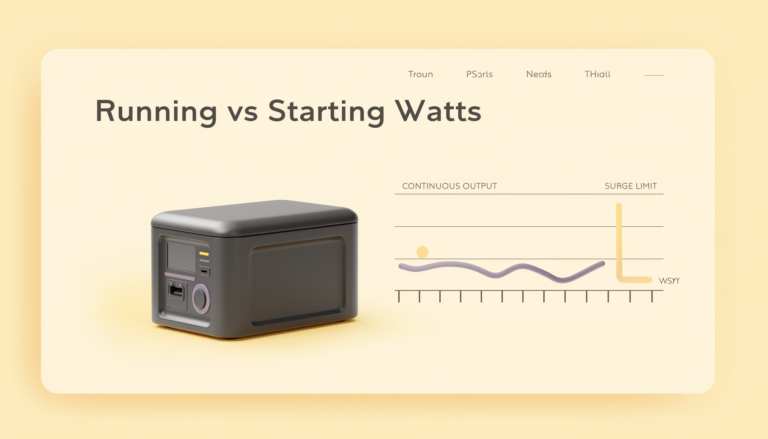
Running watts and starting watts describe two different power requirements that can determine whether a portable power station can operate an appliance successfully.
Running watts are the power a device requires during normal operation.
Starting watts are the higher, short-duration power some devices may require when a motor, compressor, pump, or similar component starts.
For portable power station sizing, the basic rule is:
This distinction is especially important for refrigerators, freezers, pumps, air-conditioning equipment, and some power tools.
A battery can have plenty of watt-hours and still fail to start a device if the station’s output system cannot support the required startup demand.
Running Watts vs Starting Watts at a Glance
| Requirement | What it means | Portable power station specification to check |
|---|---|---|
| Running watts | Power required during normal operation | Continuous output |
| Starting watts | Temporary higher power required during startup | Surge/startup/peak capability, as defined by manufacturer |
| Energy over time | Total energy consumed while operating | Battery capacity in Wh |
These three measurements should not be confused. Running watts and starting watts concern power. Watt-hours concern energy.
What Are Running Watts?
Running watts are the power a device requires while operating normally after startup. They may also be described as operating watts, rated operating power, or normal power draw, depending on the device and manufacturer.
For portable power station sizing, running watts help determine the minimum continuous power output required. If several devices operate simultaneously, their running loads generally need to be considered together.
For example, suppose three hypothetical devices require:
- Device A: 200W
- Device B: 100W
- Device C: 50W
The portable power station must provide sufficient applicable continuous output for that simultaneous load. This example is illustrative and does not represent the consumption of any particular appliance.
What Are Starting Watts?
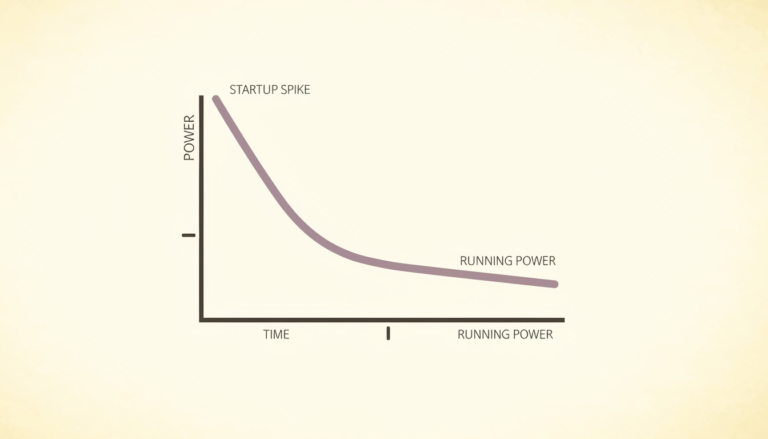
Starting watts describe the temporary increase in power that some electrical devices can require when they begin operating. This higher demand is commonly associated with electric motors, compressors, and pumps.
Examples can include refrigerators, freezers, some air conditioners, pumps, and motor-driven power tools.
A device may therefore require significantly more power during startup than after it reaches normal operation. The startup event may be brief, but the portable power station still has to handle it.
If the startup demand exceeds the station’s applicable output capability, the device may fail to start, trigger an overload condition, or cause the station’s AC output to shut down.
Why Do Motors and Compressors Need More Power at Startup?
Electric motors can draw more electrical current while accelerating from rest than they require once they are operating normally.
This is particularly relevant to compressor-driven appliances. A refrigerator might operate normally within the station’s continuous-output limit but still require a higher temporary demand when its compressor starts. Therefore, sizing from running watts alone can underestimate the required station output.
Continuous Output vs Surge Output
Portable power stations commonly publish more than one output figure. The two most important are often continuous output and surge or peak output.
Continuous output
The power level the station is designed to provide during sustained normal operation under the manufacturer’s specified conditions.
Surge or peak output
A higher temporary output level associated with short-duration loads.
Surge specifications should not be treated as universally standardized across manufacturers. Products may differ in how surge is defined, how long higher output is available, whether voltage changes under a boost mode, which appliances are supported, whether the feature applies automatically, and whether additional restrictions apply.
Never compare two products solely by a large “surge watts” number without checking how each manufacturer defines the feature.
Is Surge Output the Same as Starting Watts?
No. They describe opposite sides of the compatibility question.
Starting watts
Refer to the temporary power demand of the appliance.
Surge output
Refers to the portable power station’s temporary power-supply capability.
Successful startup requires the station to accommodate the appliance’s actual startup behavior under the applicable conditions. Appliance startup requirement must be compatible with portable power station startup/surge capability.
Why Battery Capacity Does Not Solve a Starting-Watt Problem
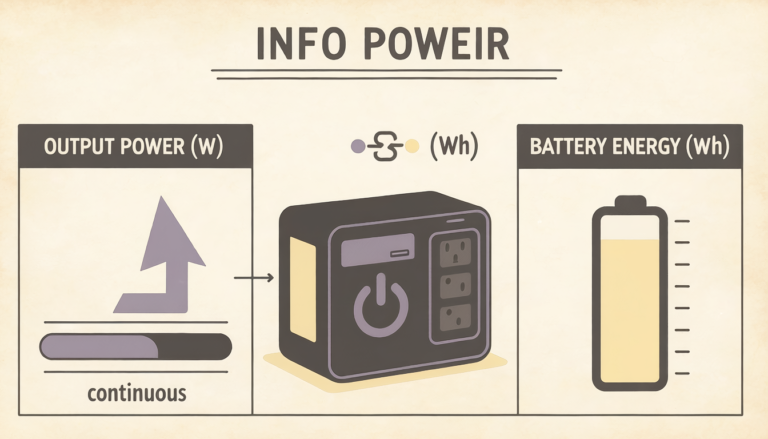
A common mistake is assuming that a higher-capacity battery automatically makes a station capable of starting a more demanding appliance. It does not.
Battery capacity is measured in Wh and determines stored energy and runtime. Output capability is measured in W and determines how much power the station can supply.
A station might contain a large battery but have an inverter that cannot support a particular startup load. Adding more watt-hours does not automatically increase the inverter’s output capability.
How Do You Find an Appliance’s Running Watts?
The preferred source is documentation for the exact device you plan to power. Useful sources include the appliance nameplate, manufacturer’s manual, technical documentation, manufacturer support information, and credible electrical measurement.
Do not automatically rely on generic internet lists of typical appliance wattage when an important backup decision depends on the exact load. Products within the same category can differ in compressor design, size, operating mode, efficiency, and startup behavior.
How Do You Find Starting Watts?
Starting demand can be more difficult to determine than normal operating wattage. Possible sources include manufacturer documentation, technical specifications, credible measurement using appropriate equipment, and published electrical data for the exact product.
If reliable starting-power data is unavailable, do not invent a multiplier and present it as an exact appliance specification. Rules such as “starting watts are always two times running watts” or “every refrigerator needs three times its running watts” are not universal facts.
A planning multiplier can only be used as an explicit assumption, not as verified data for an exact appliance.
Should You Use the Appliance’s Nameplate Wattage?
A nameplate can provide important electrical information, but what it represents must be interpreted correctly. It may list watts, volts, amps, rated input, maximum current, or other electrical characteristics.
A nameplate value does not necessarily represent average energy consumption over many hours. Use appropriate rated or maximum information for electrical compatibility and realistic average consumption for runtime estimation.
Can You Calculate Watts From Volts and Amps?
For a simple DC relationship:
For example, 12V × 5A = 60W. AC loads can involve additional electrical characteristics, so multiplying listed voltage and current should not always be treated as an exact representation of real operating power. Use manufacturer-stated wattage or reliable measured data when available.
How Do You Size a Portable Power Station for Running Watts?
Start by identifying every device that will operate simultaneously. Then add their running power.
| Device | Running load |
|---|---|
| Device A | 150W |
| Device B | 100W |
| Device C | 50W |
| Combined | 300W |
The station must provide sufficient continuous output for the combined load. But if one device has a startup surge, you must evaluate that separately.
How Do You Account for Starting Watts With Multiple Devices?
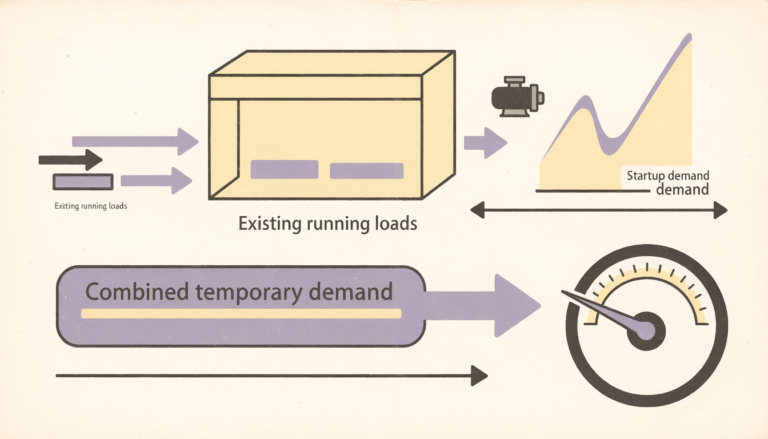
When several devices are already running, a new motor or compressor may start while the existing load remains active.
For example, if the existing load is 250W and another device starts while that load is active, the station must support the resulting temporary combined demand within its applicable operating limits.
The exact calculation should use verified device requirements rather than generic assumptions.
Do You Add All Starting Watts Together?
Only if those startup events can realistically occur at the same time. If two motor-driven devices can start simultaneously, their overlapping demand may matter. If their operation can be intentionally staggered, the maximum simultaneous requirement may be lower.
For automatic appliances such as refrigeration equipment, startup timing may be less predictable. Sizing should reflect realistic operating behavior.
What Happens If Starting Watts Are Too High?
If startup demand exceeds what the portable power station can support, the appliance may fail to start, the station may report overload, AC output may switch off, or protective circuitry may activate.
Repeatedly forcing a station to attempt an unsupported load is not a substitute for proper sizing.
What Happens If Running Watts Are Too High?
If the sustained load exceeds the station’s supported continuous output, the station may issue an overload warning, shut down its output, or refuse to support the load.
A high surge specification does not mean the station can continuously operate at that higher number. A station advertised with 2,000W surge does not automatically mean 2,000W continuous output.
Example: Running Load With Startup Demand
Consider a purely illustrative device with 300W running power and a 900W startup requirement.
The station needs to support at least the applicable 300W normal load continuously and be compatible with the 900W temporary starting requirement.
A station with 500W continuous output but insufficient startup capability could run the device after startup in theory but still fail to start it. A station with sufficient startup capability but only 250W continuous output would still be undersized for sustained operation.
Example: Several Loads Running at Once
Suppose an illustrative refrigeration load uses 200W during normal operation, while a router/electronics load uses 50W and lighting uses 50W. The combined running load is 300W.
If the first device temporarily requires a higher startup demand while the other 100W of loads remain active, the station must accommodate that total temporary condition.
How Much Extra Continuous Output Should You Have?
There is no universal headroom percentage that is correct for every portable power station and use case. Additional margin can be useful because appliance consumption can vary, specifications may represent maximum or nominal conditions differently, additional devices may be connected later, and critical backup loads benefit from conservative sizing.
Oversizing also increases cost, weight, and physical size. Choose an appropriate margin based on the importance and uncertainty of the load rather than applying one arbitrary percentage.
Does a High Surge Rating Mean the Station Can Run Anything?
No. Surge output is only one part of compatibility. You also need to check continuous output, actual appliance startup behavior, voltage requirements, output waveform where relevant, manufacturer restrictions, duration of temporary demand, and total concurrent load.
A marketing headline such as 4,000W peak should never replace reading the actual operating specifications.
What Is Power-Lifting or Boost Mode?
Some manufacturers include operating modes designed to support certain loads beyond the station’s ordinary continuous-output rating. Depending on implementation, they may alter voltage behavior, supported appliance types, or allowable duration.
Power Station Scout does not treat boost, power lifting, X-Boost, surge, and peak as universal synonyms. Each feature must be described according to exact manufacturer documentation.
Starting Watts for Refrigerators
Refrigerators are one of the most important startup-load examples because their compressors can require higher power during startup than during steady operation.
For refrigerator backup, evaluate normal running load, startup/compressor requirement, other devices operating simultaneously, station continuous output, applicable startup/surge capability, desired runtime, and battery capacity.
Do not size refrigerator backup solely from average daily energy consumption. Average energy helps estimate capacity; startup demand helps determine output compatibility.
Starting Watts for Freezers
Freezers can present similar compressor-startup considerations. Use the exact freezer’s electrical information whenever possible.
The appropriate station needs enough continuous output for normal operation, enough temporary startup capability, and enough usable battery energy for the desired backup duration.
Starting Watts for Power Tools
Motor-driven power tools can have short-duration startup demands and changing loads during use. Consider rated or operating power, startup behavior, actual workload, station continuous output, and station short-duration capability.
Do not assume a power tool listed below the station’s continuous output will necessarily operate successfully under every workload.
Do Electronics Have Starting Watts?
Many electronic devices do not have the same compressor-style startup requirement, although some can still have brief inrush or transient current behavior. Use the device manufacturer’s requirements and station compatibility information rather than assuming every load has a large starting-watts figure.
Running Watts vs Average Watts
Running watts and average energy consumption should be kept separate. An appliance may use 300W while actively running but cycle off for part of each hour.
For output sizing, the 300W operating load may still matter. For runtime, average energy consumption over time may be more useful.
Running Watts vs Watt-Hours
Running watts describe power. Watt-hours describe energy.
If an appliance draws 200W and operates continuously for four hours, theoretical energy use is:
If it cycles on and off, actual energy use can differ. Running wattage still matters for inverter compatibility, while Wh consumption matters for runtime.
Does Starting Power Affect Battery Runtime?
Startup energy consumption is normally brief compared with long-duration operation, so sustained runtime is usually driven more strongly by average energy use over time.
Starting watts primarily affect output compatibility. Average and running energy use primarily affect battery-runtime calculation.
How to Choose a Portable Power Station From Running and Starting Watts
- Identify normal running loads. Find the power required by every device that may operate simultaneously.
- Add simultaneous running loads. This establishes the base continuous-output requirement.
- Identify startup loads. Determine which motors, compressors, pumps, or other equipment create higher startup demand.
- Consider overlap. Ask what other devices will already be operating when the startup event occurs.
- Compare with station specifications. Verify continuous output, applicable surge/startup behavior, and relevant manufacturer limitations.
- Calculate capacity separately. Once output compatibility is established, determine how much battery energy is needed for desired runtime.
Running and Starting Watts Checklist
Appliance
- Exact device identified
- Running power identified
- Startup requirement identified where relevant
- Manufacturer/source recorded
- Variable operating behavior considered
Multiple loads
- Simultaneous normal loads listed
- Running watts added
- Startup overlap considered
- Staggered operation considered where practical
Portable power station
- Continuous AC output verified
- Surge/startup specification verified
- Manufacturer definition of surge checked
- Boost modes understood separately
- Correct model/generation confirmed
Energy
- Desired runtime defined
- Battery capacity calculated separately
- Usable capacity considered
Common Starting-Watt Mistakes
Using battery Wh to judge startup capability
Capacity does not determine inverter surge capability.
Using running watts only
Motor-driven devices may require more power during startup.
Treating surge output as continuous output
A temporary rating is not a sustained rating.
Assuming all manufacturers define surge identically
They may not.
Applying one startup multiplier to every appliance
Actual startup behavior varies.
Ignoring existing loads
The appliance may start while other devices are already drawing power.
Adding every possible startup event together
Only realistic simultaneous events matter.
Treating boost modes as normal inverter output
Feature behavior and restrictions must be verified.
Using generic appliance tables instead of exact-device data
Exact-device evidence is preferable when the load matters.
Frequently Asked Questions
Are starting watts higher than running watts?
For devices with meaningful startup demand, yes. The exact difference depends on the equipment.
Do all appliances have starting watts?
Not all appliances have a large or practically important startup surge. Motor- and compressor-driven loads are particularly relevant.
How long do starting watts last?
The duration depends on the device and the nature of its startup behavior. Do not assume one universal duration.
Is peak output the same as surge output?
Manufacturers may use overlapping terminology, but the exact definition and operating behavior should be verified for the specific product.
Can a 1,000W power station run a 1,000W appliance?
Not automatically. Check whether 1,000W is the station’s continuous output, the appliance’s actual operating requirement, its startup demand, and the station’s applicable limitations.
Does more Wh increase starting power?
Not necessarily. Wh describes battery energy capacity, while starting-power compatibility depends on the station’s output system.
Can I turn appliances on one at a time to reduce startup demand?
Staggering manually controlled loads can reduce overlapping startup events, but automatic equipment such as refrigerators may restart independently. Base the system design on realistic use.
The Bottom Line
Running watts and starting watts solve two different parts of portable power station output sizing.
Running watts tell you how much power a device needs during normal operation. Starting watts describe the temporary higher demand some appliances require when motors, compressors, or pumps start.
- Add the running watts of devices that operate simultaneously.
- Identify loads with meaningful startup demand.
- Consider what other devices are already running during startup.
- Verify the station’s continuous-output specification.
- Verify its applicable startup/surge behavior from the manufacturer.
- Calculate battery capacity and runtime separately.
Do not assume a large battery can compensate for insufficient output. The station must first be capable of starting and sustaining the load. Only then should you determine how much battery energy is needed to keep that load running for the desired time.
Continue through the sizing cluster
Review watts vs watt-hours, portable power station capacity, runtime calculations, or move into appliance sizing for refrigerators, freezers, and power tools.
Verify output before you size runtime
First confirm that the station can start and sustain the load. Then calculate the battery capacity required for the operating time you need.