
How to Calculate Portable Power Station Runtime
Portable power station runtime depends primarily on how much usable battery energy is available and how much power the connected device consumes.
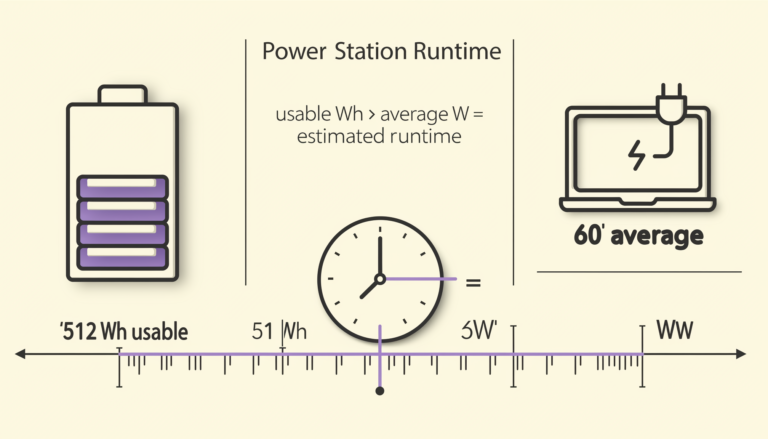
The basic calculation is:
If a power station can deliver 800Wh of usable energy and the connected device averages 100W:
That is the fundamental relationship, but real-world runtime is rarely as simple as dividing the advertised battery capacity by the appliance's maximum wattage.
To estimate runtime more accurately, you need to consider:
- rated versus usable battery capacity;
- AC conversion losses;
- power station self-consumption;
- average rather than maximum device consumption;
- cycling or variable loads;
- output method;
- battery condition;
- operating temperature.
Portable Power Station Runtime Formula
The preferred calculation is:
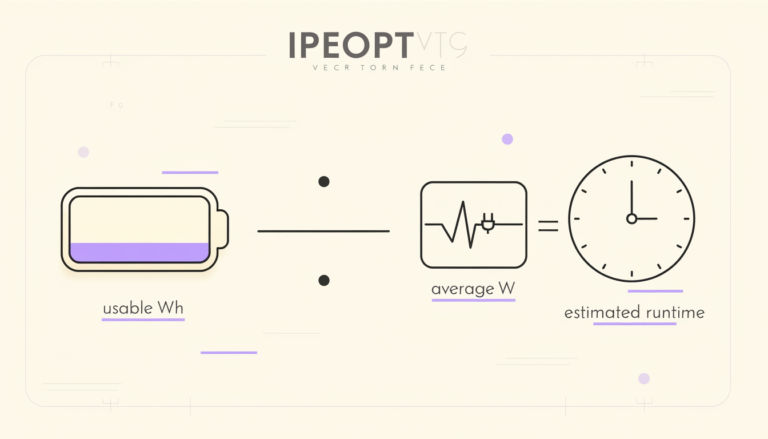
Where:
Usable energy
is the amount of battery energy actually available to the connected load.
Average device power
is the average wattage the device consumes during the period being estimated.
For a constant load, this calculation is straightforward.
For variable loads, the difficulty is estimating the correct average power consumption.
Why You Should Not Always Use Rated Battery Capacity
Portable power stations usually advertise battery capacity in watt-hours.
For example:
This is the manufacturer's rated battery-capacity specification.
It should not automatically be treated as:
Some stored energy is used or lost through processes such as:
- inverter conversion;
- battery-management electronics;
- control systems;
- cooling;
- idle operation.
The exact amount varies between products and operating conditions.
Therefore:
For the strongest runtime estimate, use credible measured usable-energy data for the exact model and relevant output method when available.
Rated Capacity vs Usable Capacity
The distinction is critical.
Rated capacity
The battery-energy specification stated by the manufacturer.
Usable capacity
The energy actually delivered to the connected load under particular conditions.
Suppose a hypothetical portable power station is rated at:
but testing under a particular AC load measures:
Then runtime calculations for a similar load should use the measured:
If the connected load is 100W:
Using rated capacity
Using measured usable energy
That difference demonstrates why runtime calculated from advertised capacity alone can be overly optimistic.
How to Estimate Runtime From Rated Capacity
When measured usable capacity is unavailable, you can still create a planning estimate from rated capacity.
The process is:
- Start with rated battery capacity.
- Apply a clearly stated usable-energy assumption.
- Divide the estimated usable energy by average load.
- State that the result is approximate.
Conceptually:
Then:
The important editorial rule is:
Never present the assumed usable fraction as though it were measured for the exact product.
Different power stations can have different real-world efficiencies.
Why There Is No Universal Runtime Efficiency Percentage
It is tempting to use one rule such as:
Multiply every battery by 0.85.
That may be useful for rough planning, but it should not be treated as universally correct.
Usable energy can differ because of:
- inverter design;
- load level;
- idle consumption;
- battery cutoff behavior;
- temperature;
- output type;
- product design.
A fixed efficiency factor is therefore an assumption unless supported by testing of the exact station under relevant conditions.
Power Station Scout should prefer:
- independently measured usable energy;
- manufacturer-specified usable energy where clearly documented;
- a transparent planning assumption.
How Device Wattage Affects Runtime
For the same usable battery energy, higher average wattage results in shorter runtime.
Suppose usable battery energy is:
100W load
200W load
400W load
This relationship explains why a single power station can provide dramatically different runtimes depending on what is connected.
Runtime is not a fixed characteristic of the battery alone.
It is a relationship between:
usable energy + connected load
Use Average Power for Runtime, Not Just Maximum Power
A device's maximum or nameplate wattage is not always the best number for estimating runtime.
Many loads vary.
Examples include:
- refrigerators;
- freezers;
- laptops;
- fans with multiple speeds;
- variable-speed equipment;
- some medical devices;
- power tools.
For output sizing, maximum and startup demand can be important.
For runtime estimation, the more useful value is often the device's average energy consumption over time.
These are different questions.
Output question
Can the power station support the device's highest relevant power demand?
Runtime question
How much energy does the device consume over the period being estimated?
How to Calculate Runtime for a Constant Load
Constant loads are easiest to estimate.
Suppose:
- usable energy = 900Wh;
- constant load = 150W.
Calculation:
Estimated runtime:
approximately 6 hours
This assumes the load actually remains close to 150W and that 900Wh is the usable energy available under those conditions.
How to Calculate Runtime for Multiple Devices
If multiple devices operate simultaneously, add their average wattages.
Example:
| Device | Average load |
|---|---|
| Device A | 80W |
| Device B | 60W |
| Device C | 40W |
| Combined | 180W |
If the station provides:
then:
This only works if all three devices operate for the same period.
If they run for different lengths of time, calculate their energy consumption separately.
How to Calculate Runtime When Devices Run for Different Times
Suppose:
- Device A: 100W for 5 hours
- Device B: 50W for 3 hours
- Device C: 20W for 8 hours
Calculate each device's energy use:
Device A
Device B
Device C
Total load energy:
The portable power station therefore needs to deliver approximately:
for those loads under the stated assumptions.
You would then choose a station with sufficient rated capacity to provide that usable energy after accounting for system losses.
Runtime for Cycling Loads
Cycling loads switch between higher consumption and lower or near-zero consumption.
Refrigerators and freezers are common examples.
Suppose a device:
- draws 200W when active;
- operates only part of each hour.
Using:
would assume it runs continuously for the entire day.
That could substantially overestimate energy use.
For cycling equipment, runtime estimates are stronger when based on:
- measured average energy consumption;
- manufacturer energy-consumption data;
- credible independent measurements.
You still need the higher operating/startup requirements for output compatibility, but average energy is more useful for runtime.
How to Estimate Refrigerator Runtime
For refrigerator backup, separate output compatibility from energy consumption.
First verify:
- normal operating wattage;
- compressor startup requirement;
- power station continuous output;
- power station applicable surge capability.
Then estimate runtime from the refrigerator's realistic average energy consumption.
A simplified relationship is:
Or, when daily energy consumption is available:
For example, if a refrigerator consumes a measured:
and the power station can deliver:
then:
which is approximately:
16 hours
under the assumptions used.
That example is illustrative only. Refrigerator consumption varies significantly by model, temperature, usage, compressor behavior, and operating conditions.
How to Estimate Freezer Runtime
Freezer runtime follows the same framework.
You need:
- sufficient output for operation;
- sufficient startup capability;
- realistic average energy consumption;
- usable station energy.
Do not use a generic freezer wattage as though every freezer consumes the same amount of energy.
Exact-model data is preferable.
How to Estimate CPAP Runtime
CPAP runtime should be estimated from the electrical requirements of the exact device and configuration.
Energy consumption can differ according to factors such as:
- machine model;
- operating mode;
- heated humidifier;
- heated tubing;
- output method;
- hours of operation.
The basic calculation remains:
But use manufacturer-supported electrical information for the exact CPAP device.
Power Station Scout should address only electrical compatibility and runtime estimation, not medical treatment decisions.
How to Estimate Laptop Runtime
Laptop power consumption can vary significantly with:
- processor workload;
- display brightness;
- battery charging state;
- connected peripherals;
- power-management settings.
If the laptop averages 50W and the power station provides 500Wh usable energy:
But that is a simplified estimate.
If the laptop's internal battery is also charging, consumption can differ.
When possible, use measured average input power for the intended workload.
How to Estimate TV Runtime
TV power consumption varies by:
- display size;
- display technology;
- brightness;
- picture settings;
- model.
If a TV averages 80W and the station provides 640Wh usable energy:
Again, the quality of the estimate depends on the accuracy of the 80W average-consumption input.
How to Estimate Router and Modem Runtime
Networking equipment often has relatively modest but continuous energy demand.
If:
- router = 12W;
- modem = 8W;
combined load:
With:
the simplified estimate is:
This illustrates why low-wattage continuous loads can run for relatively long periods.
Actual consumption must still be verified for the exact equipment.
How to Estimate Runtime for Camping
Camping usually involves several devices with different usage schedules.
A better approach is to calculate daily energy consumption.
Example:
| Device | Power | Daily use | Daily energy |
|---|---|---|---|
| Light | 10W | 5h | 50Wh |
| Laptop | 60W | 3h | 180Wh |
| Camera charging | 20W | 2h | 40Wh |
| Other load | 30W | 4h | 120Wh |
| Total | — | — | 390Wh/day |
If usable station energy is:
then:
before accounting for any additional loads or recharge input.
This type of daily energy budget is often more useful for camping than a single “runtime” number.
Runtime for Home Backup
Home backup usually involves multiple essential loads with different operating patterns.
Examples can include:
- refrigerator;
- freezer;
- Wi-Fi;
- lights;
- laptops;
- communications equipment;
- selected medical or accessibility devices.
Rather than asking:
How many hours will this power station run my house?
define the essential loads first.
Then calculate their combined energy use over the desired backup period.
For longer outages, runtime may also depend heavily on whether the power station can be recharged during the outage.
Does Inverter Load Affect Runtime?
Yes.
Using AC outlets activates the inverter, which consumes some energy.
At very low AC loads, fixed inverter consumption can represent a larger percentage of total energy use.
For example, if a small device draws only a few watts but the AC inverter itself also consumes energy, the total system demand can be meaningfully higher than the device's own wattage.
When possible, powering compatible low-voltage devices through an appropriate DC or USB output can avoid unnecessary AC conversion.
However, the actual efficiency difference is product- and load-specific.
Do not assume a universal saving percentage.
Does Leaving the AC Inverter On Reduce Runtime?
It can.
If the AC inverter remains active even when the connected load is small or intermittent, the station can consume energy simply by keeping the inverter operating.
The significance depends on:
- exact station;
- inverter design;
- load;
- duration.
This can be particularly relevant when estimating long runtimes for very low-power equipment.
Product-specific testing is preferable where this attribute materially affects a recommendation.
Does USB or DC Output Change Runtime?
Potentially.
A device powered directly through a compatible USB or DC output follows a different conversion path from a device powered through the AC inverter.
This can affect system efficiency.
For example, powering a compatible laptop directly from USB-C may avoid converting battery DC to AC and then back to DC through the laptop charger.
However, actual efficiency varies.
The strongest conclusion is:
Does Temperature Affect Portable Power Station Runtime?
Temperature can affect battery behavior and system performance.
Very cold or hot conditions may alter:
- usable battery energy;
- charging behavior;
- power capability;
- thermal-management activity.
Every power station has manufacturer-specified operating and charging temperature limits.
When runtime is important in extreme conditions, use the product's documentation and relevant independent testing rather than assuming room-temperature performance will remain unchanged.
Does Battery Age Affect Runtime?
Yes.
Rechargeable batteries gradually lose some usable capacity as they age and accumulate charge/discharge cycles.
If the battery stores less energy than when new, runtime for the same load can also decrease.
For example:
A new battery might provide:
while an aged battery under comparable conditions might provide less.
Battery chemistry, cycle history, storage, temperature, and operating conditions influence long-term degradation.
Does Charging While Using the Station Change Runtime?
If the power station is receiving energy while also powering devices, the battery-discharge rate can be reduced or, under some conditions, the battery may continue charging.
The energy relationship becomes:
when input is less than the load.
For example:
- output load = 200W;
- charging input = 100W.
Ignoring system losses for illustration:
Net battery draw is approximately:
But real behavior depends on:
- product design;
- supported pass-through operation;
- conversion losses;
- charging restrictions;
- battery state;
- temperature.
Do not assume every portable power station supports unrestricted charging while powering loads.
How Solar Charging Changes Runtime
Solar charging can extend effective operating time because energy is being added while the station powers the load.
Suppose:
- load averages 150W;
- solar input averages 100W during useful sunlight.
Ignoring losses for a simplified example:
The battery would need to supply only approximately:
during that period.
But solar input is not constant.
It changes with:
- sunlight;
- panel orientation;
- shading;
- clouds;
- temperature;
- station input limits.
Therefore, do not use the solar panel's rated wattage as though that amount of power is continuously available.
Can You Calculate Runtime From Amp-Hours?
You can, but first convert battery charge into energy using voltage.
The simplified relationship is:
Then:
Comparing Ah values without voltage can be misleading because two batteries with the same Ah rating can contain different amounts of energy when their voltages differ.
For portable power stations, Wh is usually the more useful starting point.
Can You Calculate Runtime From kWh?
Yes.
Convert kWh to Wh:
For example:
If usable energy is:
that equals:
For a 200W average load:
Again, this assumes the 1.7kWh figure represents energy actually available to the load.
Runtime vs Battery Life
These terms should not be used interchangeably.
Runtime
How long a station can support a particular load before recharging.
Battery cycle life
How many charge/discharge cycles the battery is specified to complete before reaching a defined remaining-capacity threshold.
Service life
How long the battery or station remains useful across years of ownership.
A station can have excellent cycle life but short runtime if its battery capacity is small relative to the connected load.
Runtime vs Charging Time
Runtime and recharge time answer different questions.
Runtime
How long stored energy supports the load.
Charging time
How long it takes to restore battery energy.
Both matter for repeated use.
A station may provide long runtime but recharge slowly.
Another may have less capacity but recharge quickly enough to suit the use case.
Portable Power Station Runtime Calculator Method
Use this repeatable process.
Step 1 — Identify battery capacity
Record the exact model's rated Wh.
Step 2 — Find usable energy
Otherwise document your planning assumption.
Step 3 — Determine average load
Measure or obtain realistic average device consumption.
Step 4 — Calculate runtime
Step 5 — Account for operating conditions
Consider:
- cycling loads;
- temperature;
- output type;
- battery age;
- other connected devices.
Step 6 — Report the result correctly
Use wording such as:
Estimated runtime is approximately X hours under these assumptions.
Do not say:
This station will run the device for exactly X hours
unless direct testing supports that exact claim.
Worked Example 1 — Constant Load
Assumptions:
- rated battery capacity: 1,000Wh;
- independently measured usable energy: 850Wh;
- constant load: 100W.
Calculation:
Estimated runtime:
approximately 8.5 hours
This result applies to the stated assumptions.
Worked Example 2 — Higher Load
Same usable energy:
Load:
Calculation:
Estimated runtime:
approximately 3.4 hours
Higher average power consumption reduces runtime.
Worked Example 3 — Multiple Devices
Loads:
- 60W laptop;
- 20W networking equipment;
- 10W lighting.
Combined:
Usable energy:
Calculation:
Estimated runtime:
approximately 8 hours
if all devices remain near those average loads.
Worked Example 4 — Different Usage Durations
Loads:
- 80W for 4h = 320Wh
- 40W for 5h = 200Wh
- 20W for 10h = 200Wh
Total energy:
The portable power station needs to deliver approximately:
for those activities.
This is often a better method than combining wattages when devices do not all operate for the same amount of time.
Common Runtime Calculation Mistakes
Dividing rated Wh by load W and calling the result exact
Rated capacity may exceed usable delivered energy.
Using maximum device wattage as average consumption
Variable loads may consume much less or occasionally more.
Ignoring AC inverter consumption
This can matter, particularly with low loads.
Ignoring additional devices
Every connected load consumes energy.
Confusing surge watts with runtime consumption
Surge is a temporary output requirement, not the same as sustained average energy use.
Using solar panel rated watts as guaranteed continuous input
Solar production changes constantly.
Ignoring battery age
Older batteries may provide less usable energy.
Presenting estimates as tests
Calculated runtime and measured runtime must remain separate.
Using a universal efficiency percentage
Model-specific data is preferable.
Portable Power Station Runtime Checklist
Before publishing or relying on a runtime estimate:
Power station
- Exact model identified
- Rated Wh verified
- Usable Wh available or assumption documented
- Output method identified
- Battery condition considered
Load
- Exact device identified
- Average power consumption estimated
- Startup requirement handled separately
- Cycling behavior considered
- Other simultaneous loads included
Conditions
- Temperature considered if relevant
- Charging input considered
- Solar contribution treated realistically
- Output losses considered
Result
- Formula shown
- Units correct
- Assumptions stated
- Result labeled estimated
- Not represented as hands-on testing
Frequently Asked Questions
How long will a 1,000Wh portable power station last?
It depends on the usable energy delivered by the station and the average wattage of the connected load. The 1,000Wh rating alone cannot determine exact runtime.
How long will a power station run a 100W device?
Use:
For example, 800Wh usable energy gives an estimated eight hours at a constant 100W load.
How long will a 500Wh station run a 50W load?
If the full 500Wh were usable, the theoretical result would be:
Actual runtime is typically different because rated Wh is not necessarily fully delivered to the load.
Does a 2,000Wh station run twice as long as a 1,000Wh station?
If usable-energy proportion, load, and operating conditions are otherwise equivalent, twice the usable energy can theoretically provide approximately twice the runtime. Real products may differ in efficiency.
Does higher inverter output reduce runtime?
Maximum inverter rating itself does not determine runtime, but the connected load and inverter operating losses do. A higher-power appliance will generally consume stored energy faster.
Is calculated runtime accurate?
It can be useful for planning when the inputs are realistic, but it remains an estimate unless directly measured.
What is the best number to use for runtime calculations?
Credible measured usable energy for the exact station and realistic average power consumption for the exact load provide the strongest starting point.
The Bottom Line
Portable power station runtime is determined by the relationship between:
usable battery energy
and:
average load power
The core formula is:
For accurate planning:
- verify the station's rated battery capacity;
- use measured usable energy when credible data exists;
- estimate the device's realistic average consumption;
- include all simultaneous loads;
- account for cycling behavior and operating conditions;
- treat the result as an estimate rather than a guaranteed measurement.
Do not calculate runtime from battery capacity alone.
A portable power station's runtime has meaning only when the battery is connected to a specific load under specific conditions.
Continue your sizing research
Use the usable-capacity guide, compare watts vs watt-hours, review running vs starting watts, or return to the main portable power station sizing guide.
Calculate runtime from the load you actually need to support
Verify usable battery energy, realistic average consumption, and operating conditions before treating any runtime figure as a planning estimate.
How to Choose a Portable Power Station