
What Size Portable Power Station Do You Need for Power Tools?
For power tools, choose a portable power station by first deciding whether you need to run a corded tool directly or recharge cordless-tool batteries. Those are different electrical loads.
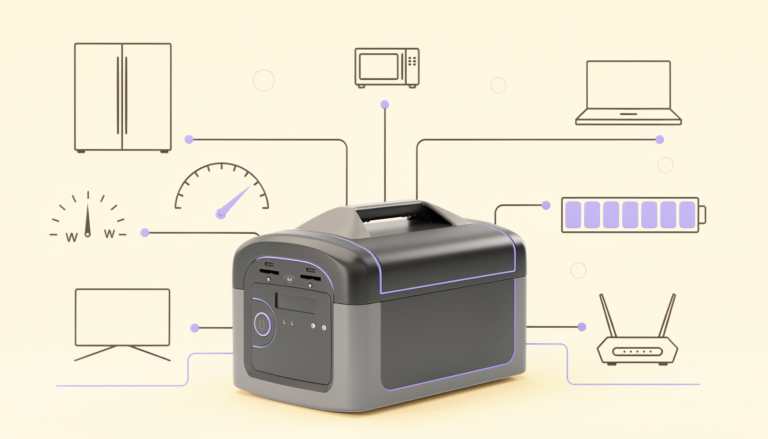
For a corded tool, check:
running/maximum input → startup demand → load under actual cutting, drilling, grinding, or pumping → simultaneous tools
Then calculate battery energy from:
average active watts × total active operating time
For cordless tools, the portable power station normally powers the battery charger, not the tool motor itself.
In that case, check:
charger AC input → number of chargers running simultaneously → tool-battery watt-hours to replace → charging losses
As rough planning classes:
500–1,000Wh can be useful for charging cordless-tool batteries and light jobsite electronics;
1–2kWh with a 1.5–2kW-class inverter can support some lighter corded tools and substantial battery charging;
2–3kWh+ with a strong 2–3kW-class inverter and documented short-duration capability is a more realistic class to investigate for demanding corded saws, grinders, hammers, and mixed jobsite use;
compressors and other difficult motor loads can require substantially more startup capability and should be sized from exact manufacturer data.
Those are planning classes only.
A power station that runs one:
800W heater
does not automatically behave the same way with an:
800W motor-driven tool.
Power tools can change demand rapidly during startup and when the cutting or drilling load increases. That distinction is already part of Power Station Scout's compatibility framework.
First Decide: Corded Tool or Cordless Battery Charger?
This is the most important branch in power-tool sizing.
Corded Power Tool
The energy path is:
portable power station battery
→ AC inverter
→ power-tool motor/electronics
Examples include:
corded circular saw;
corded miter saw;
angle grinder;
hammer drill;
rotary hammer;
shop vacuum;
corded compressor.
The portable power station has to deal directly with:
motor startup;
changing mechanical load;
temporary overload;
actual running demand.
Cordless Power Tool
The energy path is usually:
portable power station battery
→ AC inverter
→ cordless-tool charger
→ tool battery
→ tool
The power station does not need to supply the cordless tool's motor power directly.
It only needs to supply the charger.
That can make cordless-tool charging a much easier load for a portable power station than running an equivalent corded tool directly.
But fast chargers and multi-bay charging systems can still create substantial AC loads, so the exact charger must be checked.
Power Tools Do Not Have One Universal Wattage
“Power tool” covers an enormous electrical range.
Current manufacturer examples illustrate the variation.
Bosch Hammer Drill Example
The Bosch HD18-2 corded hammer drill is specified at:
120V;
8.5A;
variable speed;
up to 3,200 no-load RPM.
DEWALT Angle Grinder Example
The DEWALT DWE402 uses:
120V;
an 11A motor;
11,000 RPM.
DEWALT Circular Saw Example
The DEWALT DWE575SB uses:
120V;
a 15A motor.
DEWALT Miter Saw Example
The DEWALT DWS715 uses a:
120V motor;
15A motor;
and its current manual lists:
1,600W maximum input.
Bosch Breaker Hammer Example
The Bosch BH2760VC is a much more demanding 15A tool. Bosch specifically says it can operate from a:
115/120V AC/DC 15A outlet
or a:
2,500W portable generator.
These are exact-model examples.
They do not establish universal wattage classes for every drill, grinder, saw, or hammer.
Why Motor Startup Matters So Much for Power Tools
Motor-driven tools can briefly demand much more current when starting.
DEWALT provides an unusually useful real-world example.
For its 15A miter-saw and thickness-planer motors, DEWALT says typical startup current is approximately:
30–45A for a brief second
while no-load current can be approximately:
6–7A.
That is a huge difference.
It shows why this sizing method is unreliable:
15A tool × 120V = 1,800W, therefore any 1,800W station must run it.
The tool's brief startup behavior can be much more demanding than its steady operating condition.
The portable power station therefore needs:
sufficient continuous output;
appropriate short-duration capability;
compatible overload behavior.
A high advertised surge number still does not guarantee that every motor below that number will start successfully.
Do Not Use One Starting-Watt Multiplier for Every Tool
Avoid rules such as:
motor watts × 2
or:
motor watts × 3
as though they were universally correct.
Power-tool startup changes according to:
motor design;
soft-start electronics;
tool type;
mechanical condition;
blade or accessory;
starting load;
portable power station inverter behavior.
The DEWALT 30–45A miter-saw example demonstrates how large startup current can become on one tool family, but it should not be applied to every circular saw, grinder, or drill.
Use exact manufacturer information or credible measurement where possible.
See Running Watts vs Starting Watts for Portable Power Stations for the complete methodology.
Running Power Can Change When the Tool Starts Cutting
A power tool's electrical load is often variable.
A saw spinning with no material contact is not necessarily representative of:
ripping lumber;
cutting thick hardwood;
binding a blade;
cutting masonry.
Likewise, a drill spinning freely is different from:
drilling concrete;
driving a large fastener;
boring a large hole.
The project framework already recognizes that a power tool may operate successfully at no load and then demand substantially more power during actual work.
For portable power station sizing, distinguish:
no-load behavior
from:
actual working load.
Amps Are Useful, but Do Not Blindly Convert Motor Amps to Exact Watts
Many corded tools are labeled in:
amps
rather than watts.
For a simple planning calculation:
V × A
can show the electrical scale of the load.
For example:
120V × 15A = 1,800VA
But for an AC motor, volts × amps describes apparent electrical power and should not automatically be treated as exact real watts under every operating condition.
Power factor and changing motor load can matter.
This is why an exact manufacturer wattage or credible measurement is preferable when available.
The DEWALT DWS715 is a useful example:
15A motor;
120V;
manufacturer manual lists 1,600W maximum input.
Do not turn every 15A power-tool label into a universal:
1,800W actual consumption
claim.
What Size Portable Power Station Do You Need for a Circular Saw?
A corded circular saw can be one of the more challenging ordinary jobsite tools.
The current DEWALT DWE575SB, for example, has a:
15A, 120V motor.
For a tool in this class, a portable power station should have:
substantial continuous AC output;
strong documented short-duration capability;
enough battery energy for the actual cutting duty cycle.
A roughly:
2kW continuous inverter class
may be a reasonable minimum class to investigate for many heavy 120V corded saws.
But that should not be read as:
“every 2,000W power station will run every 15A circular saw.”
Motor startup, station overload response, material load, and concurrent equipment can still determine success.
A larger 2–3kW-class inverter can provide more practical headroom for jobsite use.
What Size Portable Power Station Do You Need for a Miter Saw?
Miter saws can have particularly demanding startup behavior.
The DEWALT DWS715 is currently specified with:
15A motor;
1,600W maximum input.
But DEWALT separately states that typical startup current for its 15A miter-saw motors can reach:
30–45A briefly.
That is why a power station with:
1,600W continuous output
is not automatically a good match merely because the manual says 1,600W maximum input.
For a demanding miter saw, prioritize:
documented motor-start capability
rather than selecting only from continuous inverter watts.
A robust:
2–3kW+ inverter class
may be a more realistic category to investigate, but exact compatibility still needs to be verified.
What Size Portable Power Station Do You Need for an Angle Grinder?
Current DEWALT DWE402-family angle grinders provide an 11A motor example.
A grinder's load can change significantly with:
pressure applied;
material;
wheel type;
wheel condition;
binding.
That means the no-load electrical requirement does not completely describe actual use.
For an 11A, 120V-class corded grinder, a portable station in roughly the:
1.5–2kW continuous-output class
is a more useful starting range than a small sub-1kW inverter.
The exact tool and station still need to be matched.
Battery capacity then depends on total grinding time.
What Size Portable Power Station Do You Need for a Drill or Hammer Drill?
Some drills are less demanding than 15A saws.
The Bosch HD18-2 example uses:
8.5A at 120V.
A lighter drill may therefore work from a smaller inverter than a large circular or miter saw.
But hammer drilling into masonry can materially increase mechanical loading compared with spinning the drill unloaded.
Do not select a station from:
no-load RPM
or:
drill category
alone.
Use:
rated electrical input;
actual operating load where known;
startup behavior;
simultaneous equipment.
What Size Portable Power Station Do You Need for a Rotary or Breaker Hammer?
Large concrete tools can move the requirement into a substantially higher class.
Bosch's current BH2760VC breaker hammer uses a:
15A
supply and Bosch explicitly says it can operate from a:
2,500W portable generator.
That generator statement should not be translated directly into:
“a 2,500W portable power station is guaranteed to work.”
Generator and battery-inverter overload behavior can differ.
But it demonstrates the electrical class of the tool.
For heavy demolition tools, investigate portable stations with:
high continuous AC output;
strong motor-start behavior;
substantial battery capacity;
good thermal management.
Air Compressors Are a Special Case
An electric air compressor can be one of the hardest jobsite loads for a portable power station.
Current DEWALT compressor examples include 15A, 120V motors.
Motor startup is the major issue.
DEWALT goes as far as recommending:
no less than a 5,000W generator
for its hand-carry electric compressors.
Again, that is generator guidance, not a claim that every 5kW portable power station will work.
The important conclusion is:
do not size a compressor from running amps alone.
If an air compressor is central to your jobsite plan, verify:
exact compressor model;
startup requirement;
station short-duration capability;
manufacturer compatibility;
required compressor duty cycle.
What Size Battery Capacity Do Corded Power Tools Need?
Once output compatibility is established, calculate energy.
The basic formula remains:
Wh = average power × active operating hours
But power tools are often intermittent.
A saw might be switched on for only a fraction of a workday.
Example: High-Power Saw Used Intermittently
Suppose, only for illustration, that a tool averages:
1,600W while actively cutting
and accumulates:
10 minutes of active motor time.
Energy:
1,600 × 10/60 ≈ 267Wh
For:
30 minutes of cumulative active use:
1,600 × 30/60 = 800Wh
This shows why a high-wattage tool does not necessarily require an enormous battery if its active duty cycle is short.
But a 1kWh power station also has to absorb inverter losses and may be powering other equipment.
These values are calculations, not measured tool-session energy.
Duty Cycle Matters More Than “Hours on the Jobsite”
Do not calculate:
tool watts × eight-hour workday
unless the tool genuinely runs for eight hours.
A circular saw may be present for an entire workday but operate for only:
seconds per cut;
minutes per hour.
A grinder may run for longer stretches.
A shop vacuum may operate continuously.
A compressor may cycle automatically.
For battery sizing, use:
actual cumulative active runtime
or, better:
measured Wh per real work session.
This is more useful than jobsite duration alone.
Example: Mixed Corded Tool Session
Suppose an illustrative work period includes:
Circular saw:
1,500W average active × 12 minutes
Energy:
1,500 × 12/60 = 300Wh
Grinder:
1,000W average active × 15 minutes
Energy:
1,000 × 15/60 = 250Wh
Drill:
600W average active × 10 minutes
Energy:
600 × 10/60 = 100Wh
Total theoretical load energy:
650Wh
before station losses.
The inverter still needs to be sized from the largest relevant simultaneous and startup event, not the 650Wh total.
This is another example of why:
watts and watt-hours solve different parts of the problem.
Charging Cordless Tool Batteries Is a Different Problem
For cordless tools, the portable power station normally runs the charger.
Check the charger label for:
AC input voltage;
AC input amps or watts;
number of charging bays;
simultaneous vs sequential charging.
Do not size the power station from:
cordless-tool motor output;
tool battery voltage alone;
charger marketing speed alone.
Do Not Confuse Charger Output Amps With Wall Input Amps
This is an easy mistake.
The DEWALT DCB118 is sold as an:
8 Amp Fast Charger.
But DEWALT explicitly notes that the rated 8A figure is the maximum charging output current for compatible battery packs.
It does not mean:
8A × 120V = 960W AC input
from the wall.
Use the charger's actual AC input rating.
This distinction matters whenever charger specifications use battery-side amps rather than wall-side watts.
How Much Energy Does Recharging a Cordless Tool Battery Need?
A useful first approximation for battery energy is:
nominal battery voltage × amp-hours = nominal watt-hours
Makita 18V 5Ah Example
Makita's BL1850B is specified at:
18V;
5.0Ah.
Nominal pack energy:
18V × 5Ah = 90Wh
That does not mean recharging the battery from a portable power station will consume exactly 90Wh.
The energy path includes:
PPS battery → inverter → charger → tool battery
and every conversion stage has losses.
So the portable power station must supply more than the energy ultimately stored in the pack.
DEWALT 20V MAX 5Ah Example
DEWALT's DCB205 is marketed as:
20V MAX, 5Ah
but DEWALT specifies that its nominal voltage is:
18V.
A nominal energy calculation is therefore:
18V × 5Ah = 90Wh
again before charging losses.
This is why using:
20V × 5Ah = 100Wh
would overstate the pack's nominal-energy basis for this calculation.
How Many Tool Batteries Can a 500Wh Power Station Recharge?
Suppose each battery stores approximately:
90Wh nominal
as in an 18V 5Ah example.
Four batteries contain:
90 × 4 = 360Wh
of nominal stored energy.
A 500Wh-rated portable power station might appear large enough on paper.
But the station must also cover:
inverter losses;
charger losses;
its own operating consumption;
any reserve.
Therefore:
500Wh rated ≠ guaranteed four full 90Wh battery recharges from empty.
Use independently measured usable energy where available or keep sufficient margin.
Do not invent one universal efficiency percentage.
How Many Tool Batteries Can a 1,000Wh Power Station Recharge?
Using the same 90Wh nominal pack example:
Eight packs contain:
90 × 8 = 720Wh
of stored energy.
A 1kWh-class power station may therefore provide a practical base for multiple cordless-tool recharges.
But exact recharge count depends on:
starting SOC of each pack;
charger efficiency;
power-station inverter efficiency;
battery charging taper;
station reserve.
The correct claim is:
calculate from actual energy transferred
rather than promising a fixed number of packs from battery capacity alone.
Fast Chargers Can Change the Inverter Requirement
A single ordinary tool charger may be a modest load.
A high-speed or multi-bay charger can be much larger.
Milwaukee's current four-bay simultaneous Super Charger is substantial enough that Milwaukee says:
only one should be connected to a 15A circuit;
two can be used on a 20A circuit.
That does not tell you its exact wattage.
It does demonstrate why:
“battery chargers are always tiny loads”
is not a safe assumption.
If you plan to operate several high-speed chargers from one power station, add their actual AC inputs.
Sequential vs Simultaneous Multi-Bay Charging
Multi-bay chargers can behave differently.
Some charge:
one pack at a time
while others charge:
several packs simultaneously.
Milwaukee's M18/M12 Rapid Charge Station, for example, can charge three batteries simultaneously, while some other chargers are sequential.
That difference matters for portable power station output.
A charger holding six batteries does not necessarily draw the combined power needed to charge all six at full rate simultaneously.
Read the charger architecture.
Charger Runtime Is Not the Same as Energy Requirement
Makita states that its DC18RC can recharge the BL1850B 18V 5Ah battery in approximately:
45 minutes.
That charge time does not, by itself, reveal exact AC watt-hours withdrawn from the power station.
The charger:
varies current;
manages battery temperature;
tapers charging;
consumes some energy internally.
Use charge duration for planning time.
Use actual Wh or input data for battery-capacity planning.
Is It Better to Run Corded Tools or Recharge Cordless Batteries?
It depends on the work.
Corded Tools
Advantages:
no intermediate tool battery;
direct use of power-station energy;
no waiting for recharge.
Challenges:
higher inverter output;
motor startup;
changing mechanical load;
heavy AC demand.
Cordless Tools
Advantages:
charger load can be more predictable;
tool startup is handled by its own battery;
smaller power station may be sufficient;
batteries can be charged between jobs.
Challenges:
conversion losses;
limited number of battery packs;
charge time;
high-speed multi-bay chargers can still draw significant AC power.
For intermittent field work, a cordless-tool ecosystem can be easier to support from a moderate portable power station than running multiple large corded motors directly.
That is not universal.
Can a 1,000W Power Station Run Power Tools?
Some tools, yes.
Others, no.
A 1,000W-class inverter may support:
smaller drills;
some sanders;
many cordless battery chargers;
selected lower-power tools.
It is unlikely to be a reliable universal solution for:
15A circular saws;
large miter saws;
demanding grinders;
compressors;
large demolition tools.
The exact tool controls the answer.
Can a 1,500W Power Station Run Power Tools?
A 1,500W station expands the range, but demanding motor tools can still exceed it or fail at startup.
For example:
the DEWALT DWS715 manual lists 1,600W maximum input;
current Breach? no, this exact miter saw therefore already exceeds a 1,500W continuous station on the published input figure.
Even tools with published running requirements below 1,500W can have challenging startup demand.
So:
1,500W ≠ universal power-tool compatibility.
Can a 2,000W Power Station Run Power Tools?
A 2kW continuous inverter is a useful class for many jobsite tools.
It can potentially support:
heavy drills;
many grinders;
many circular saws;
some miter saws;
tool chargers.
But a demanding 15A motor can still challenge startup capability.
DEWALT's published 30–45A brief-start current for 15A miter saws is the clearest warning against treating 2,000W as an automatic guarantee.
Can a 3,000W Power Station Run Most Corded Tools?
A 3kW-class inverter provides substantially more headroom, but “most power tools” is still too broad to guarantee.
Heavy loads can include:
large air compressors;
demolition hammers;
table saws;
multiple simultaneous tools;
dust extraction;
heaters used for jobsite work.
Some motor loads can demand significant startup current.
A large inverter reduces compatibility risk but does not remove the need to verify exact equipment.
Does a 15A Tool Need a 1,800W Power Station?
Not necessarily.
A 15A, 120V branch-load calculation suggests:
120 × 15 = 1,800VA
but motor starting current can be much higher.
The DWS715 miter saw is also an example where DEWALT lists:
15A motor;
1,600W maximum input;
while DEWALT says 15A miter-saw startup current can momentarily reach 30–45A.
So this shortcut is not sufficient:
15A tool → buy 1,800W inverter.
Check startup behavior.
Do Brushless Power Tools Behave Differently?
Potentially.
Brushless tools use electronic motor controls rather than traditional brush/commutator architecture.
Those electronics can affect:
startup;
speed control;
load response.
But “brushless” does not provide enough information to determine portable power station size.
Use exact tool electrical requirements rather than assuming:
brushless = lower startup watts
or:
brushed = larger surge.
Variable-Speed Tools Also Have Variable Power Demand
A variable-speed drill or grinder does not necessarily draw its nameplate maximum continuously.
Power demand changes with:
trigger position;
torque;
material;
accessory;
stall conditions.
For output sizing, you still need sufficient capacity for the relevant maximum operating condition.
For battery-energy estimation, measured average demand during the actual task can be more useful.
What Happens if a Tool Binds or Stalls?
Mechanical binding can increase motor demand sharply.
Examples:
saw blade pinches;
drill bit binds;
grinder wheel stalls.
Some modern tools have electronic protection that shuts down or disengages.
Others can present a severe load to the inverter.
Do not size a portable power station around only the tool's lightest workload.
Also do not repeatedly force a stalled tool to run against the power station's overload protection.
Power Tools and Simultaneous Loads
Jobsite equipment often operates together.
Examples:
saw + dust extractor
tool + battery charger
compressor + charger
miter saw + shop vacuum
The station must support the combined load.
Illustrative Example
Suppose:
Saw during cut: 1,500W
Dust extractor: 800W
Battery charger: 250W
Combined running load:
2,550W
A:
2,000W continuous inverter
would not qualify for that simultaneous hypothetical load.
You may be able to reduce the requirement with load management:
stop charging while cutting;
run the extractor only when needed;
but safety-critical dust control should not be disabled merely to keep an undersized power station from overloading.
Saw + Shop Vacuum Can Be Harder Than the Saw Alone
Dust extraction is easy to overlook.
If a saw and shop vacuum start together, both may involve motors.
That can produce:
higher simultaneous running load;
overlapping startup demand.
Some workshop tools include automatic vacuum activation.
In that setup, size the power station around the actual combined startup behavior rather than adding only the steady-state wattages.
Air Compressor + Power Tool
If the compressor cycles automatically while another tool is running, you may not control when the motor startup occurs.
That makes it risky to assume:
I will simply run them one at a time
unless the compressor is deliberately shut off and the workflow supports that safely.
For an automatic motor load, include its possible startup in the concurrent-load analysis.
How Much Battery Do You Need for a Full Workday?
| Jobsite load | Active time | Calculated energy |
|---|---|---|
| Circular saw at assumed 1,500W average | 15 min | 375Wh |
| Grinder at assumed 1,000W average | 20 min | 333Wh |
| Drill at assumed 500W average | 15 min | 125Wh |
| Chargers | Measured separately | — |
| Lights | 50W × 6h | 300Wh |
Do not size from:
8 hours × tool nameplate watts
unless the equipment truly runs continuously.
Instead create an energy log.
Example:
Tool subtotal before charger energy:
1,133Wh
This is an illustrative worksheet.
Actual tool demand changes with workload.
For serious jobsite planning, measured energy per task is preferable.
When a 1kWh Battery Can Still Be Useful for High-Power Tools
A small battery can support a high-power tool if:
the inverter is large enough;
the tool runs only briefly.
Suppose:
Tool load: 1,600W
Active runtime: 10 minutes
Energy:
267Wh theoretical
A station with only:
1kWh
of rated capacity can contain enough energy for several short work periods.
But if its inverter is only:
1,000W
the tool cannot run at all.
Again:
capacity cannot compensate for insufficient output.
When a Large Battery Can Still Fail
Now suppose:
Battery capacity: 3,000Wh
Inverter: 1,200W
Tool requirement: 1,600W
The station contains plenty of energy.
It still does not qualify.
A large battery is not evidence of:
stronger AC output;
stronger surge;
better motor-start capability.
Extension Cords Matter With High-Power Tools
A portable power station may be positioned away from the cutting area for:
dust protection;
safety;
convenience.
That can require an extension cord.
Use a correctly rated cord that follows the tool manufacturer's requirements.
DEWALT's DWS715 manual warns that significant voltage reduction can cause loss of power and overheating and provides extension-cord gauge guidance based on tool current and cord length.
DEWALT's compressor documentation similarly warns that undersized extension cords can cause voltage drop, loss of motor power, and overheating.
Do not use a thin household extension cord merely because the power station itself is portable.
Should the Power Station Sit Next to the Tool?
Not necessarily.
Keep the power station away from:
cutting debris;
metal grinding sparks;
excessive dust;
water;
blocked ventilation.
Grinding sparks and conductive metal dust are particularly poor companions for exposed electrical equipment.
Use appropriate cable management and follow the tool and power-station manuals.
Do not put the station in a location where its cooling vents become covered with sawdust.
Does Pure Sine Wave Matter for Power Tools?
Use a normal full-sine AC portable power station as the baseline for modern corded tools and chargers.
Power tools can contain:
variable-speed electronics;
brushless controllers;
charger power electronics.
A physically compatible AC outlet does not prove that every inverter waveform is appropriate.
Follow the exact equipment requirements.
Can You Use a Power Station while it is charging on a Jobsite?
Some portable power stations support simultaneous charging and output.
But check the exact model for:
pass-through limits;
bypass behavior;
combined input/output restrictions;
thermal limits.
A high-power corded tool can create a very different simultaneous charging/output condition than a laptop.
See Can You Use a Portable Power Station while it is charging? for the detailed behavior.
solar charging for Power Tools
Solar can help replace energy between tool sessions.
But a:
400W solar input
does not mean a 1,500W saw is being “powered by 400W solar.”
The battery supplies the difference while the saw runs.
The relevant energy relationship is:
tool energy consumed − solar energy harvested = net battery depletion
For example:
Tool/charger energy during the day:
1,500Wh
Actual solar harvested:
800Wh
Net battery depletion:
700Wh
before other system losses.
See How to Charge a Portable Power Station With Solar Panels for compatibility.
Why Does a Power Tool Shut the Station Off?
Likely causes include:
motor startup exceeds station capability;
tool demand rises under mechanical load;
combined loads exceed continuous output;
compressor or vacuum starts simultaneously;
battery SOC is low;
temperature/protection limits are reached.
Power Station Scout's troubleshooting framework specifically notes that power tools can create:
startup surge;
changing power demand;
charger-specific behavior.
If the station shuts down:
stop the tool;
remove unnecessary loads;
inspect the station's overload/error indication;
compare exact tool input with station specifications;
do not repeatedly reset protection without correcting the cause.
See Why Does My Portable Power Station Keep Shutting Off?.
Corded vs Cordless Power Tool Sizing Example
Suppose you need to make cuts with a cordless circular saw.
Option A: Run a Corded Saw
Portable station must directly handle:
motor startup;
full cutting load;
possibly ~1.5kW+ active demand depending on exact tool.
Energy is consumed only when the saw runs.
Option B: Charge Cordless Batteries
Suppose each battery stores:
90Wh nominal
and you need four full battery-equivalent recharges.
Stored energy:
90 × 4 = 360Wh
Actual power-station energy required will be greater because of conversion and charging losses.
The inverter requirement may be much lower because it only runs the charger.
This is why cordless tools can make a smaller power station practical even if the cordless tool itself is capable of heavy work.
Power Tool portable power station sizing Checklist
Before buying, record whether you will:
run corded tools directly
or:
charge cordless batteries
For corded tools, record:
exact tool model;
voltage;
amps/watts;
startup information;
actual work load;
simultaneous tools;
dust extractor/vacuum;
compressor;
active duty cycle.
For cordless charging, record:
battery model;
nominal voltage;
Ah or Wh;
charger model;
charger AC input;
charge time;
simultaneous charger count;
batteries recharged per day.
Then calculate separately:
required continuous AC output
required startup capability
and:
required battery Wh
Do not use one number for all three.
Frequently Asked Questions
What size portable power station do I need for power tools?
It depends heavily on whether you are running corded tools or recharging cordless batteries.
For battery charging alone, a smaller 500Wh–1kWh-class station can be useful if its inverter supports the charger load.
For demanding corded tools, roughly 2–3kW-class continuous output with strong motor-start capability is a more realistic category to investigate.
Exact tool data controls the decision.
Can a 1,000W portable power station run power tools?
Some.
A 1,000W station may run smaller drills and chargers.
It is not a universal solution for 15A saws, heavy grinders, compressors, or demolition equipment.
Can a 1,500W portable power station run a circular saw?
Some circular saws may exceed that class or create startup demands the station cannot handle.
A current DEWALT DWE575SB uses a 15A, 120V motor.
Check the exact saw and inverter.
Can a 2,000W portable power station run a circular saw?
Potentially.
A 2kW station is a useful class to investigate for many corded saws, but motor startup can still determine compatibility.
Do not treat 2,000W as a guarantee.
Can a 2,000W power station run a miter saw?
Potentially, but demanding miter saws can have large startup current.
DEWALT says its 15A miter-saw motors can momentarily draw roughly 30–45A at startup.
The station needs appropriate short-duration motor-start capability.
Can a 3,000W power station run a miter saw?
A 3kW-class inverter provides more headroom and may be a much better match for demanding saws.
But exact startup compatibility still needs to be verified.
A high inverter rating does not guarantee every motor will start.
Can a power station run an angle grinder?
Yes, when it meets the grinder's running and startup requirements.
Current DEWALT DWE402-family models provide an 11A, 120V example.
Load can increase when grinding pressure rises or a wheel binds.
Can a power station run a hammer drill?
Potentially.
Current Bosch hammer drills include models such as the HD18-2 at 8.5A/120V.
Use exact tool electrical data and allow for actual drilling load.
Can a portable power station run an air compressor?
Potentially, but compressors can be particularly difficult motor-start loads.
DEWALT recommends no less than a 5,000W generator for its hand-carry electric compressors, illustrating the size of the startup challenge.
Do not infer direct portable-power-station compatibility from running amps alone.
Can a portable power station charge cordless tool batteries?
Usually, when the station is compatible with the battery charger's AC input.
Check the charger—not the cordless tool's motor rating.
How much battery does it take to charge a 5Ah tool battery?
You need the battery's nominal voltage.
An 18V 5Ah battery contains approximately:
18 × 5 = 90Wh nominal
of stored energy.
The portable power station must supply more than 90Wh for a full recharge because the charging process is not lossless.
How many 18V 5Ah batteries can a 1,000Wh power station charge?
Each contains about:
90Wh nominal
so ten packs would represent:
900Wh stored energy.
A 1,000Wh-rated power station will not generally provide ten full zero-to-100% recharges because conversion losses and station reserve must be considered.
The real number will be lower and depends on the station and charger.
Does a rapid charger need a larger power station?
Possibly.
Fast chargers can demand more AC input than slow chargers.
Multi-bay simultaneous chargers can be substantially larger loads.
Check the charger's AC input rating.
Can I plug several tool chargers into one power station?
Yes, if:
total simultaneous charger input remains within the station's continuous output;
the outlets and power strip are appropriately rated;
the station has enough battery energy.
Also determine whether the chargers actually charge simultaneously or sequentially.
How many watt-hours does a circular saw use?
There is no universal answer because saw load and cutting time vary.
If an illustrative saw averages:
1,500W
for:
10 minutes cumulative cutting time
theoretical energy is:
250Wh.
Use measured work-session energy for better jobsite planning.
Does a power tool use full rated watts all the time?
Usually not necessarily.
Demand can change with:
speed;
material;
mechanical load;
cutting pressure;
binding.
Use rated or maximum information for compatibility, and realistic average/measured consumption for runtime planning.
Why can my station run a heater but not a tool with similar watts?
A heater is largely a steady resistance load.
A motor-driven power tool can produce:
startup current;
changing demand;
transient overloads.
Two loads with the same steady wattage can therefore behave differently on the inverter.
Should I use a boost or power-lifting mode for power tools?
Do not assume so.
Boost modes can alter output behavior and are not universal substitutes for sufficient continuous or startup capability.
Use the normal inverter specification unless the station manufacturer explicitly supports the exact tool/load type in that mode.
Is a 1kWh or 2kWh battery better for a jobsite?
That depends on total active tool time and how many cordless packs need charging.
A high-power tool used for only a few minutes can have modest Wh consumption.
Several chargers and lights operating all day can consume more total energy.
Calculate the job rather than choosing from jobsite duration alone.
Bottom Line
To size a portable power station for power tools, first separate:
corded-tool operation
from:
cordless battery charging.
For a corded tool, the critical sequence is:
tool electrical requirement
→ motor startup
→ load under real work
→ simultaneous equipment
→ continuous/surge qualification
→ active runtime
→ battery Wh
Motor startup can be substantial.
DEWALT says its 15A miter-saw motors can briefly draw roughly 30–45A at startup, which demonstrates why matching a tool's nameplate running value to a power station's continuous watts is not enough.
For cordless systems, the calculation changes to:
charger AC input
→ number of chargers
→ tool-battery Wh
→ number of recharges
→ conversion losses
An 18V 5Ah battery stores approximately:
90Wh nominal
so several battery recharges can often be supported by a moderate 500Wh–1kWh-class station when the charger output requirement qualifies.
For demanding corded saws, grinders, or hammers, a 2–3kW-class inverter with strong documented motor-start capability is a more realistic category to investigate.
Compressors can be harder still and require exact startup verification.
The central rule is:
power tools are not steady loads.
Choose from the motor's real electrical behavior and actual job duty cycle—not from battery capacity or a generic “tool wattage” chart.
Next guide: TV sizing →