
How to Choose a Portable Power Station
Choosing a portable power station starts with your power requirements—not with a brand, battery size, or product price.
Calculate the Size You Need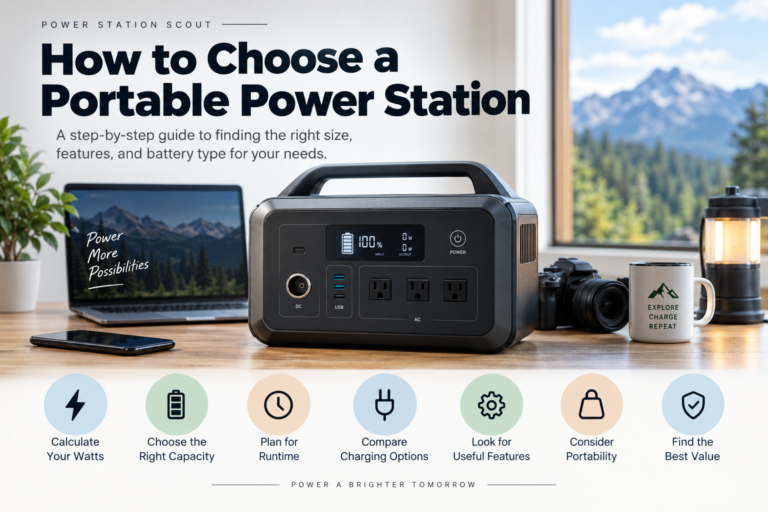
The right portable power station must provide enough continuous output for the devices you want to run, enough surge output for loads that require extra power at startup, and enough usable battery capacity for the runtime you need. After those minimum requirements are established, you can compare battery chemistry, charging speed, solar input, weight, ports, UPS/EPS capability, expandability, warranty, and price.
A simple selection process is:
- List what you need to power.
- Calculate the watts required at the same time.
- Check startup or surge requirements.
- Decide how long the devices need to run.
- Estimate the battery capacity required.
- Add an appropriate operating margin.
- Compare charging options and features.
- Choose only among stations that meet the requirements.
This guide walks through that process step by step.
Start With What You Need to Power
Before comparing portable power stations, write down the devices and appliances you actually expect to use.
For example, your list might include:
- refrigerator;
- freezer;
- Wi-Fi router and modem;
- laptop;
- monitor;
- television;
- CPAP equipment;
- lights;
- fan;
- microwave;
- coffee maker;
- phones and tablets;
- power tools.
Then separate them into two groups:
Devices that may run at the same time
These determine your required continuous output.
Devices you can use one at a time
These may still affect the maximum output you need, but their wattages do not necessarily have to be added together.
This distinction can prevent unnecessary oversizing.
If you need to power a refrigerator, router, laptop, and several lights simultaneously, for example, the station must be able to support their combined operating load.
If a microwave will only be used while another large load is turned off, the requirement can be different.
The goal is not to buy the largest station available. It is to define the electrical workload the station must support.
Determine How Many Continuous Watts You Need
Portable power station output is normally expressed in watts (W).
Continuous output tells you how much power the station is designed to provide during normal operation.
To estimate the continuous output you need:
- Find the operating wattage of each device.
- Identify which devices will run simultaneously.
- Add their wattages together.
- Compare that total with the station's continuous-output specification.
For example, if several devices operating together require a combined 700W, a power station with only 500W of continuous AC output would not meet that requirement.
Battery capacity does not solve this problem.
A station can have a large battery and still have insufficient inverter output for a particular load.
This is why watts and watt-hours must be evaluated separately.
Check Starting and Surge Watts
Some appliances temporarily require more power when they start than they use during normal operation.
This is especially relevant to equipment containing:
- compressors;
- motors;
- pumps;
- certain power tools.
A refrigerator is a common example. Its normal running demand may be much lower than the short-duration demand that occurs when its compressor starts.
Portable power stations may therefore publish both:
- continuous output, and
- surge or peak output.
Do not assume that surge terminology is identical across every manufacturer. Check how the manufacturer defines the specification and whether any duration or operating limitation is stated.
A station should be evaluated against both the normal and startup requirements of the intended load.
Determine How Much Battery Capacity You Need
Once the station's required power output is known, determine how much stored energy you need.
Portable power station battery capacity is commonly expressed in watt-hours (Wh).
A simple theoretical energy calculation is:
For example:
A constant 100W load running for five hours theoretically consumes:
That does not mean a station advertised as exactly 500Wh should automatically be selected.
The calculation still needs to account for real-world factors such as:
- conversion losses;
- station self-consumption;
- changing appliance loads;
- usable rather than merely rated battery energy;
- operating conditions.
The theoretical result is therefore a starting point for sizing, not a guaranteed runtime prediction.
Decide How Long You Need Backup Power
Capacity only becomes meaningful when it is connected to a desired runtime.
Ask:
How many hours must these devices operate before I can recharge the station?
That answer may be very different depending on the use case.
Short outage
You may only need enough energy to keep essential electronics and refrigeration operating for several hours.
Overnight CPAP use
Runtime must cover the intended overnight period with appropriate assumptions about the actual device configuration and consumption.
Camping
You may need enough energy for several days, but you may also have opportunities to recharge through a vehicle or compatible solar panels.
Home backup
The requirement depends on which loads are considered essential and how long you expect them to operate.
Instead of beginning with:
Should I buy a 500Wh, 1,000Wh, or 2,000Wh station?
begin with:
What am I powering and how long must it operate?
The capacity requirement follows from the answer.
Do Not Treat Rated Capacity as Fully Usable Energy
The watt-hour figure printed on a portable power station is a battery specification. It should not automatically be treated as the exact amount of energy that will reach an AC appliance.
Energy can be consumed by:
- inverter conversion;
- cooling;
- displays and control electronics;
- idle operation;
- battery-management functions.
The actual amount of usable energy can also vary with the load and operating conditions.
For this reason, two stations with the same rated battery capacity do not necessarily deliver identical runtime.
When independent testing exists, measured usable energy can help evaluate this difference. Otherwise, runtime estimates should clearly state the assumptions being used.
Leave a Reasonable Operating Margin
Choosing a station that only barely meets a calculated requirement can leave little room for:
- measurement uncertainty;
- unexpected startup loads;
- additional devices;
- varying appliance consumption;
- conversion losses;
- future needs.
That does not mean you should automatically buy a station twice as large as necessary.
Instead, choose a reasonable margin based on how critical the load is and how predictable its consumption is.
For a nonessential camping load, a tight estimate may be acceptable.
For important outage loads, a larger margin may be more useful.
The correct margin is therefore a decision variable, not one universal percentage for every buyer.
Compare Battery Chemistry
Battery chemistry affects long-term ownership characteristics such as:
- cycle-life specification;
- weight;
- thermal behavior;
- expected battery longevity;
- product design and cost.
Many current portable power stations use lithium iron phosphate, commonly abbreviated LiFePO4 or LFP. Other lithium-ion chemistries are also used.
Do not choose a product from chemistry alone.
Two LiFePO4 stations can still differ substantially in:
- capacity;
- output;
- charging performance;
- weight;
- ports;
- software;
- expansion;
- warranty;
- value.
Battery chemistry is therefore an important selection attribute, but it remains one part of the full product profile.
Check the Manufacturer's Cycle-Life Specification
Cycle life can help compare expected battery longevity, but the number needs context.
When evaluating a cycle-life claim, check:
- the number of cycles specified;
- the remaining-capacity threshold associated with that claim;
- the manufacturer's stated test or warranty conditions, where available.
Do not assume two products are equivalent merely because both advertise a high cycle count.
Also remember that:
- cycle life is not runtime.
- Runtime describes how long a load operates on a charge.
- Cycle life describes repeated battery cycling over longer-term ownership.
Compare Charging Speed
A large battery is less convenient if it takes too long to recharge for your use case.
Check:
- maximum supported AC charging input;
- manufacturer-stated recharge time;
- whether fast charging can be limited through settings;
- charging behavior under different conditions.
Recharge time can be particularly important for:
- frequent power outages;
- travel;
- short turnaround between uses;
- emergency preparation.
A buyer who regularly has access to grid electricity may prioritize fast AC charging.
A user spending several days away from grid power may care more about solar or vehicle charging.
Current manufacturer guidance likewise emphasizes capacity and output as primary selection factors, with charging method, chemistry, and use case affecting the final decision.
Check Solar Charging Compatibility
If you plan to use solar panels, do not evaluate the panel wattage alone.
Check the power station's supported solar-input specifications, including relevant:
- input voltage range;
- current limit;
- maximum solar input;
- connector requirements.
A solar panel and a portable power station need to be electrically compatible.
A large solar array does not force the station to accept unlimited charging power. The station's input system imposes its own limits.
Solar recharge time is also affected by:
- available sunlight;
- shading;
- weather;
- panel angle and orientation;
- temperature;
- charging losses;
- the station's input limit.
Solar charging should therefore be treated as a variable charging source rather than a guaranteed fixed recharge rate.
Consider Vehicle Charging
Vehicle charging can be useful for:
- road trips;
- RV use;
- van travel;
- repeated off-grid use.
However, charging capability varies substantially among systems.
Some stations rely on a conventional vehicle outlet, while others may support separate higher-power charging accessories.
If vehicle charging is important to you, evaluate the exact charging method and compatibility before choosing a model.
Do not assume every station provides the same charging speed simply because it can connect to a vehicle.
Check the Number and Type of Outputs
A station needs both enough power and the correct interfaces for your devices.
Possible outputs include:
- AC receptacles;
- USB-A;
- USB-C;
- 12V DC connections;
- specialized high-current outputs on some models.
Ask:
How many AC devices will I connect?
A station may have adequate total inverter output but too few conveniently available outlets.
Do I need high-power USB-C?
Laptop and device charging may be easier when the USB-C output can directly provide the required power.
Do I need DC power?
Some camping, RV, automotive, and communications equipment may use DC connections.
Can all required ports be used simultaneously?
Check product documentation for shared limits where relevant.
More ports are only valuable if they match your actual equipment.
Decide Whether UPS or EPS Functionality Matters
Some portable power stations can remain connected between a wall outlet and a load, then switch to battery power when grid electricity is interrupted.
Manufacturers may describe this using terms such as:
- UPS;
- EPS;
- backup mode.
These terms should not be assumed to mean exactly the same thing across all products.
If you need backup operation for sensitive equipment, verify:
- whether the feature is supported;
- transfer or switchover behavior;
- applicable output limits;
- device compatibility;
- manufacturer instructions.
Do not select a product based only on the presence of the letters “UPS” in marketing copy.
Decide Whether You Need Expandable Capacity
Some portable power stations support additional batteries.
Expansion can be valuable if you want to:
- increase backup duration later;
- build a larger home-backup system gradually;
- avoid replacing the main power station when energy requirements grow.
But expandability may also increase:
- total system cost;
- weight;
- storage requirements;
- complexity.
Check whether the expansion batteries are compatible with the exact product generation you are considering.
Do not assume batteries from one model family work with another.
Consider Weight and Portability
More capacity often requires a larger and heavier system.
That tradeoff matters because “portable” can describe very different products.
Ask:
- Will I carry the station frequently?
- Will it mostly stay in one room?
- Does it need to fit inside a vehicle?
- Are stairs involved?
- Does the model have practical handles or wheels?
- Can one person move it comfortably?
A heavier station may be acceptable for home backup but inconvenient for frequent camping.
A very lightweight station may be easy to carry but provide insufficient energy for long outages.
The correct choice depends on the relationship between:
capacity + output + physical portability.
Consider Noise
Battery power stations generally avoid the engine noise associated with fuel generators, but they are not necessarily silent.
Models may use cooling fans during:
- heavy loads;
- high-rate charging;
- warm operating conditions.
If the station will be used near:
- a bed;
- CPAP equipment;
- a home office;
- a campsite at night,
noise characteristics may matter.
Manufacturer claims can provide a starting point, but credible independent testing is preferable when comparing actual acoustic behavior.
Check Operating and Storage Conditions
Portable power stations have specified environmental limits.
Check the manual for:
- charging temperature;
- discharge/operating temperature;
- storage conditions;
- moisture exposure;
- ventilation requirements.
A station suitable for climate-controlled home backup may face different conditions during winter camping or hot-weather vehicle travel.
Product selection should therefore reflect where the unit will actually be used.
Evaluate Safety Information
A portable power station stores a substantial amount of energy, so safety should be part of product selection.
Check:
- manufacturer safety documentation;
- battery-management protections;
- product certifications/listings where applicable;
- operating instructions;
- current recall information;
- condition of chargers and cables.
The U.S. Consumer Product Safety Commission identifies standards related to high-energy batteries and lists UL 2743 as the Standard for Portable Power Packs.
A certification or safety claim should be verified for the exact product rather than assumed from the brand name.
Check Warranty and Support
Warranty can matter more for an expensive portable power station than for a small consumer battery pack.
Compare:
- warranty duration;
- what the warranty covers;
- whether registration is required for any extension;
- U.S. support availability;
- replacement/repair process where stated.
Do not simply compare the number of warranty years.
A useful evaluation also considers whether the exact product, battery, accessories, and expansion system are covered under the terms that matter to you.
Compare Price Only After Technical Qualification
Price should not be the first filter unless budget is a hard constraint.
A cheaper station is poor value if it cannot run the intended load.
Likewise, the most expensive station may provide capacity or features you do not need.
A better sequence is:
Value can then be evaluated using factors such as:
- capacity;
- output;
- charging;
- battery chemistry;
- useful features;
- warranty;
- portability;
- suitability for the intended use.
Do You Need a Small or Large Portable Power Station?
“Small” and “large” are useful descriptions only when connected to a requirement.
A smaller station may be appropriate when you prioritize:
- phones;
- laptops;
- cameras;
- networking equipment;
- lighting;
- low-power travel use.
A larger station may be needed when you prioritize:
- long refrigerator backup;
- multiple simultaneous appliances;
- high-power cooking equipment;
- power tools;
- larger RV loads;
- extended home backup.
Do not select the capacity category before identifying the load.
The load determines the useful product class.
Do You Need a Portable Power Station for Home Backup?
For home backup, begin by defining essential loads.
Rather than attempting to power everything automatically, ask:
- Does the refrigerator need backup?
- Does the freezer?
- Internet equipment?
- Medical or accessibility equipment?
- Lighting?
- Computers?
- Heating-related electronics?
- Cooking equipment?
Then determine:
- their simultaneous running power;
- any startup demand;
- required operating duration.
Home-backup selection may also give greater importance to:
- higher capacity;
- expansion batteries;
- UPS/EPS behavior;
- charging speed;
- long-term battery longevity.
Do You Need a Portable Power Station for Camping?
Camping selection usually introduces different priorities.
Along with capacity and output, consider:
- weight;
- size;
- trip duration;
- charging opportunities;
- solar compatibility;
- USB outputs;
- nighttime noise;
- operating temperature.
A station that is excellent for stationary home backup may be unnecessarily heavy for frequent camping.
Do You Need a Portable Power Station for an RV?
RV requirements vary depending on which loads the portable power station is expected to support.
Important considerations may include:
- appliance wattage;
- startup loads;
- daily energy use;
- charging while traveling;
- solar charging;
- physical storage;
- DC outputs.
Do not assume that a portable power station replaces every component of an RV electrical system.
Define the exact loads and connection method first.
Common Portable Power Station Buying Mistakes
Buying by watt-hours alone
Capacity does not tell you whether the inverter can support the load.
Buying by maximum watts alone
High output does not guarantee long runtime.
Ignoring startup power
A motor or compressor can require more power during startup.
Assuming rated capacity equals usable capacity
Real-world delivered energy can differ from the battery's headline rating.
Buying too much capacity without considering weight
Large batteries can reduce practical portability.
Ignoring recharge speed
A station that meets your runtime requirement may still be inconvenient if you cannot recharge it quickly enough.
Assuming all solar panels are compatible
Voltage, current, connector, and input limits matter.
Treating UPS and EPS as universal specifications
Verify the exact manufacturer's implementation.
Comparing products from different generations without checking model identity
Specifications can change substantially between generations with similar names.
Choosing a recommendation before defining your requirements
The product should fit the use case—not the other way around.
Portable Power Station Buying Checklist
Before choosing a model, record the following.
Power requirements
- Devices/appliances listed
- Simultaneous loads identified
- Running watts determined
- Startup/surge requirements checked
- Required continuous output determined
Energy requirements
- Desired runtime determined
- Required watt-hours estimated
- Usable-capacity differences considered
- Operating margin considered
Charging
- AC charging acceptable
- Recharge time acceptable
- Solar input checked if needed
- Vehicle charging checked if needed
Battery
- Chemistry verified
- Cycle-life specification reviewed
- Battery longevity considered
Features
- Required AC outlets
- Required USB ports
- DC outputs if needed
- UPS/EPS if needed
- Expandability if needed
- App/connectivity if useful
Physical requirements
- Weight acceptable
- Dimensions acceptable
- Handles/wheels appropriate
- Environmental conditions compatible
Ownership
- Safety information checked
- Warranty reviewed
- U.S. product/support status verified
- Current price compared after qualification
How to Make the Final Decision
The best way to choose a portable power station is to reduce the market to products that meet your minimum requirements before comparing secondary features.
Use this order:
1. Required continuous output
The station must support your normal simultaneous load.
2. Required surge capability
The station must handle relevant startup demand.
3. Required usable energy
The battery must support the desired runtime.
4. Charging requirements
You must be able to restore the energy fast enough for your use case.
5. Ownership requirements
Compare chemistry, weight, ports, UPS/EPS, expansion, warranty, and other relevant attributes.
6. Value
Compare price only among products that already qualify.
That process prevents one attractive specification from dominating the decision.
A station with a huge battery but insufficient output is wrong for the load.
A high-output station with too little capacity may run the appliance but not for long enough.
A feature-rich station that is too heavy to move may be wrong for camping.
The correct portable power station is the one whose overall specification profile matches the job you need it to perform.
The Bottom Line
Choose a portable power station by starting with your devices, their power requirements, and the runtime you need.
First determine the necessary continuous and surge output. Then calculate the required battery capacity. Once those minimum specifications are known, compare battery chemistry, recharge performance, solar compatibility, ports, UPS/EPS capability, expandability, weight, warranty, and price.
The most useful buying question is therefore not:
Which portable power station has the biggest battery?
It is:
Which portable power station meets my actual power and energy requirements with the features, portability, and ownership characteristics I need?
If you have not calculated those requirements yet, do that before comparing individual models.
Ready to size your power station?
Use the next guide to calculate the capacity and output requirements for your actual devices and runtime.
What Size Portable Power Station Do I Need?